
Capital Update – For the Week Ending Sept. 19, 2025
In the National Pork Producers Council’s weekly recap: NPPC’s Stateler, Zieba attend WTO Public Forum 2025; NPPC comments on state laws with out-of-state impacts; and Hoskins, Hutchins confirmed as USDA undersecretaries. Take a deeper dive below.

Listen to the Capital Update Here!
NPPC’s Stateler, Zieba Attend WTO Public Forum 2025
What happened: NPPC President Duane Stateler, a pork producer from Ohio, and Vice President of Government Affairs Maria C. Zieba attended the World Trade Organization Public Forum in Geneva, Switzerland.
The Public Forum is the WTO’s largest outreach event, providing a platform for interested stakeholders from around the world to discuss the latest developments in global trade and propose ways of enhancing the multilateral trading system.
The main aim of the 2025 forum was to “explore how digital advancements are redefining standards within the international trading system and enhancing global connectivity, innovation, and cooperation.”
In addition to participating in other WTO discussions, Stateler and Zieba collaborated with the Washington International Trade Association on outreach efforts to members of the WTO, attended various panel discussions, and met bilaterally with representatives from several missions to discuss ongoing issues and areas of collaboration.
Why it matters: Currently made up of 164 member countries, the WTO deals with the rules of trade between nations. Its goal is to ensure trade flows as smoothly and predictably as possible.
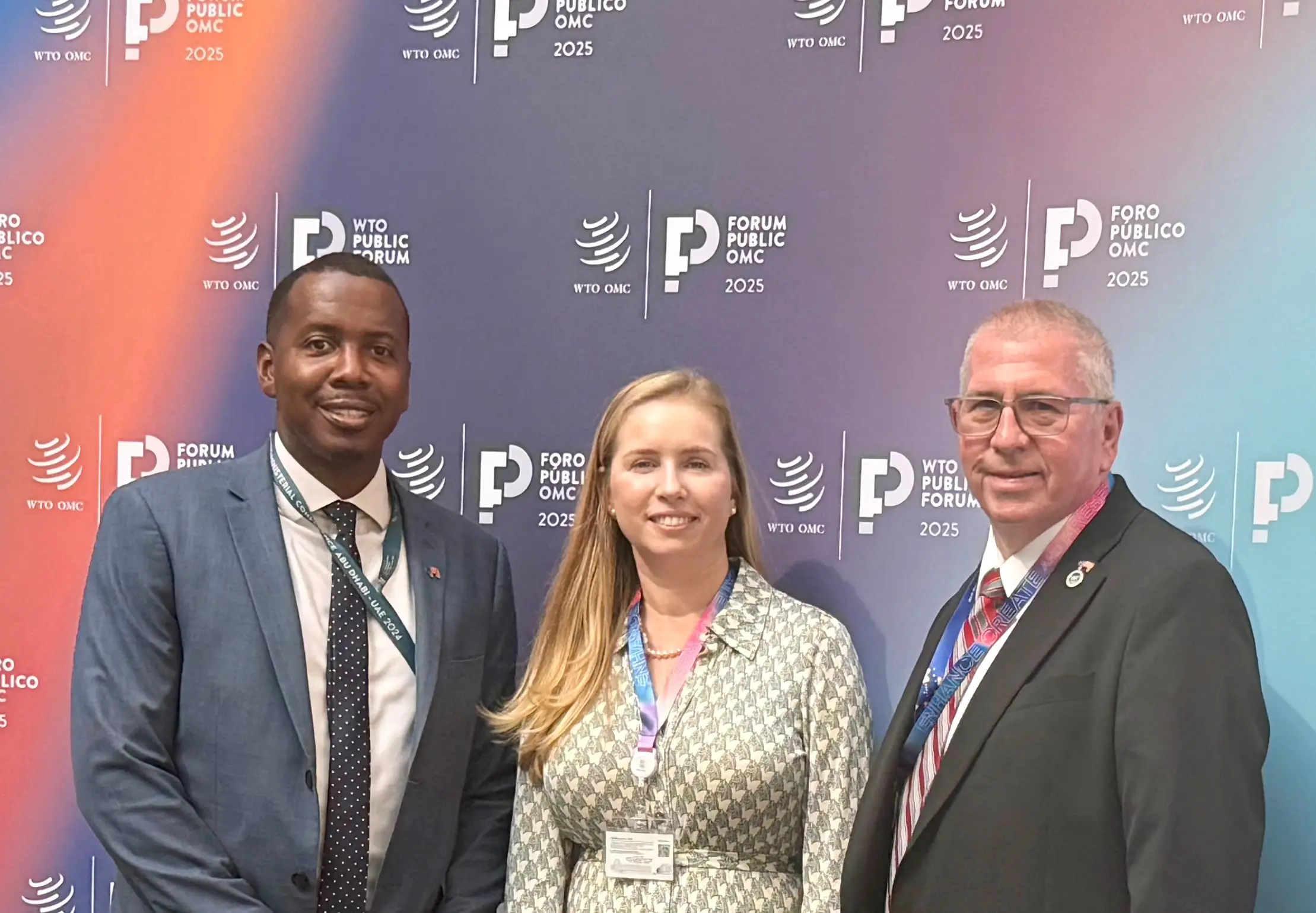
Left to right: Acting Minister Counselor for Ag Affairs Kyle Bonsu, NPPC Vice President of Government Affairs Maria C. Zieba, and NPPC President and Ohio pork producer Duane Stateler.
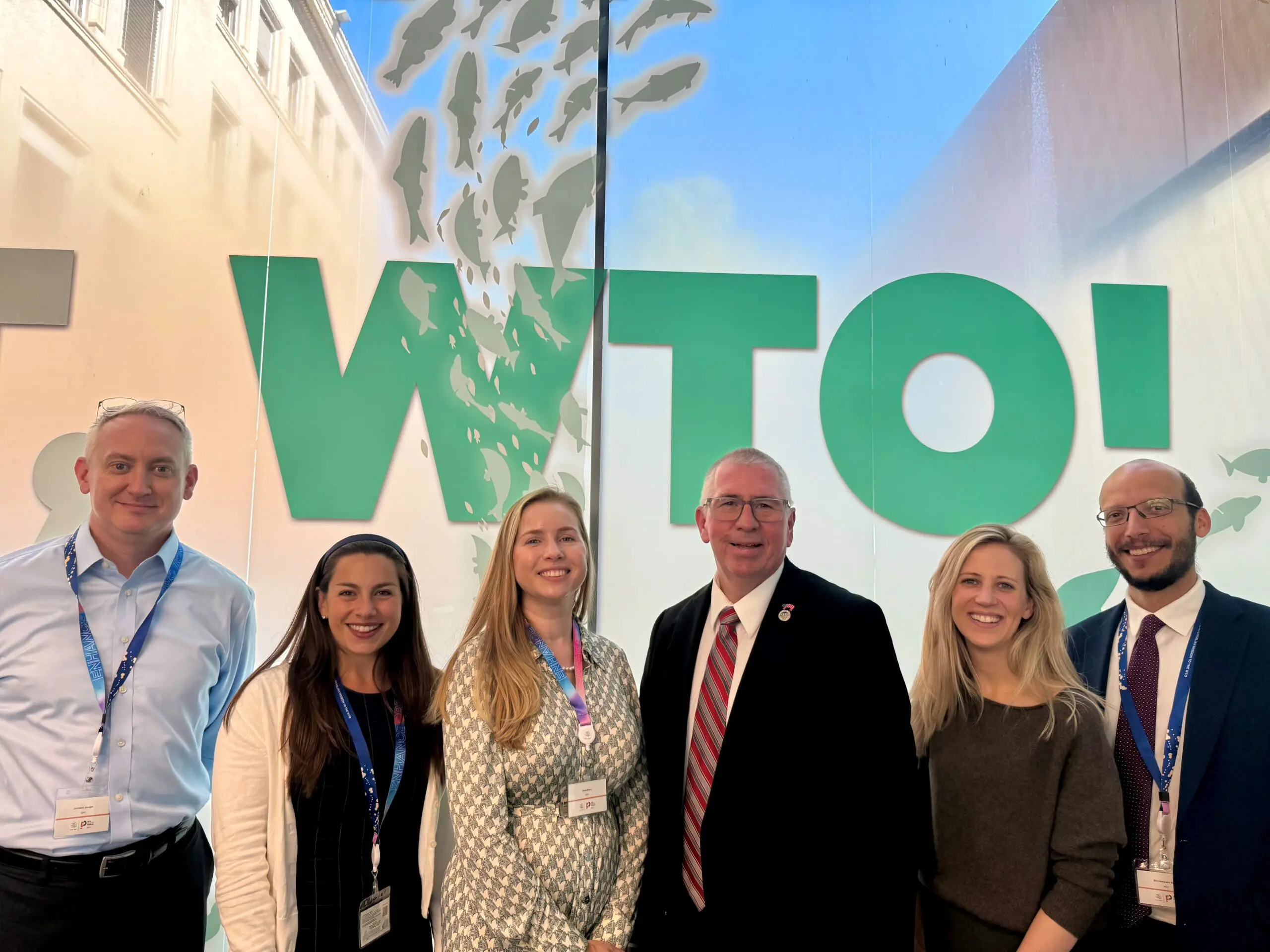
NPPC’s Stateler and Zieba with Senate Finance Committee staff.
NPPC Comments on State Laws with Out-of-State Impacts
What happened: NPPC submitted comments on state laws that have out-of-state economic impacts to the U.S. Department of Justice Antitrust Division and the National Economic Council. The comments are in response to a request from DOJ’s Office of Legal Policy for information that can help identify such laws.
Noting that recently states have enacted laws mandating certain agricultural production practices even for out-of-state farmers, NPPC singled out California Proposition 12 and Massachusetts Question 3, both of which ban in the state the sale of pork from hogs born to sows raised in housing that doesn’t meet their arbitrary standards. The California law has hurt that state’s consumers, with pork prices rising, and increased pork production costs for farmers throughout the country.
Even local-level laws can disrupt and cause economic harm, said NPPC. San Francisco’s 2017 Antibiotic Use in Food Animals Ordinance, for example, requires larger grocery retailers in the city to report detailed information about the use of antibiotics in meat and poultry products. It imposes significant reporting mandates on retailers that inevitably shift responsibility to producers, most of whom have no connection to San Francisco. In Chicago, to ensure that “institutional food purchasing advances an equitable, healthy, fair, local, humane, and sustainable food system,” pork was eliminated from the city school system’s menu.
Why it matters: U.S. pork producers are all too familiar with the challenges posed by disruptive extraterritorial regulations at the federal, state, and local levels. Burdensome and often poorly reasoned statutory and regulatory mandates impose economic harm. Usually, that harm manifests as both direct increases in the production costs a family farm faces and a dramatic reduction in the marketplace for their products. Such regulations, and the uncertainty they create in the marketplace, also can lead to additional disruptions.
By addressing the extraterritorial impact of these laws, policies, and regulations, the Trump administration can help foster a more resilient and sustainable pork industry, ensuring that our farmers can continue to provide high-quality, affordable pork to families across the country while maintaining the economic vitality of rural communities, NPPC said in its comments.
Hoskins, Hutchins Confirmed as USDA Undersecretaries
What happened: The Senate voted to confirm the nominations of Dudley Hoskins as undersecretary for the U.S. Department of Agriculture’s Marketing and Regulatory Programs and Scott Hutchins as undersecretary for USDA’s Research, Education, and Economics.
Hoskins was counsel on the Senate Committee on Agriculture, Nutrition, and Forestry and previously was senior adviser to then-Agriculture Secretary Sonny Perdue and chief of staff for the MRP mission area in the first Trump administration. The MRP includes the Agricultural Marketing Service and the Animal and Plant Health Inspection Service.
Also serving during Trump’s first term, Hutchins was deputy undersecretary for the REE mission area, which consists of the Agricultural Research Service, Economic Research Service, National Agricultural Statistics Service, National Institute of Food and Agriculture, and the Office of the Chief Scientist.
NPPC’s take: NPPC strongly supported both Hoskins and Hutchins’ nominations. In May, NPPC joined nearly 120 national and state agricultural organizations on a letter supporting Hoskins’ nomination and urging the Senate agriculture panel to approve him.
Why it matters: The MRP undersecretary oversees the agencies that facilitate domestic and international marketing of U.S. agricultural products, protect U.S. plant and animal health, regulate genetically engineered organisms, administer the Animal Welfare Act, and carry out wildlife damage management activities. The undersecretary also helps set national and international standards.
The REE undersecretary oversees programs that ensure a safe, sustainable, and competitive food system through integrated research, analysis, and education. The undersecretary also serves as the conduit between the federal government and land-grant universities.