

Capital Update – For the Week Ending Dec. 5, 2025
In this week’s recap from the National Pork Producers Council: China failed to meet ‘Phase One’ commitments, says NPPC and other ag groups; 527 agriculture and business organizations voice support for USMCA; NPPC comments on H-2A Visa wage regulation; and Pork Leadership Institute class travels to Mexico. Take a deeper dive below.

Listen to the Capital Update Here!
China Failed to Meet ‘Phase One’ Commitments, Says NPPC & Other Groups
What happened: NPPC was among ag groups who submitted comments to the Office of the U.S. Trade Representative on the agency’s Section 301 investigation of China over its failure to live up to commitments made under the “Phase One Agreement.”
Section 301 of the U.S. Trade Act of 1974 allows the president to take actions, including imposing tariffs, if a foreign government’s policies or practices violate an international trade agreement or are unjustified, unreasonable, or discriminatory and burden or restrict U.S. commerce.
In late October, USTR initiated the investigation for China’s failure to comply with the Jan. 15, 2020, U.S.-China Economic and Trade (Phase One) Agreement, including obligations related to agriculture. A public hearing on the matter is set for Dec. 16.
NPPC’s take: In its comments, NPPC pointed out that China has not met its commitment to conduct a risk assessment on ractopamine use in pork and beef production. The Asian nation bans the feed additive despite its approval by the U.S. Food and Drug Administration and the U.N.’s food-safety standards-setting body – the Codex Alimentarius Commission – deeming ractopamine as safe and setting a maximum residue limit for it (MRLs are the maximum allowable amount of a drug or additive that can remain in food products and not be a concern for human health). Ractopamine is accepted by more than 30 countries.
Under the Phase One Agreement, China was supposed to work with U.S. experts on a ractopamine risk assessment and form a joint working group to discuss steps to be taken based on the results of the assessment.
Why it matters: China’s failure to meet its Phase One Agreement commitments over the past five years has limited U.S. agricultural exports to the Asian nation. Specific to ractopamine, which increases the amount of pork produced and lowers feed costs, China’s failure to conduct a risk assessment on the feed additive – and allow imports of pork produced with it – also restricted U.S. pork exports to a major consumer of pork.
527 Agriculture, Business Organizations Voice Support for USMCA
What happened: In anticipation of an assessment of the U.S.-Mexico-Canada Agreement, NPPC and more than 500 other agriculture and business organizations representing all 50 states voiced their strong support for the North American trade deal, which, they said, “remains critical to our economic future…”
On the sixth anniversary of its implementation in July next year, the United States, Canada, and Mexico will hold a joint review to assess USMCA’s performance and determine its future.
In a Dec. 1 letter to U.S. Trade Representative Jamieson Greer, 527 U.S. agriculture and business groups pointed out that more than 13 million American jobs depend on trade with Canada and Mexico. “The case for maintaining this agreement is strong,” they wrote.
“USMCA ensures U.S. manufacturers, farmers, and service providers can continue to access the Canadian and Mexican markets,” said the organizations. “It guarantees that virtually all U.S. exports enter these markets tariff-free and helps American companies and the workers they employ compete in our top two export markets.”
In October, NPPC and more than 125 other agriculture and food organizations submitted formal comments on the review of the trade agreement, urging USTR to be cautious when considering modifications to the USMCA. NPPC also submitted its own comments.
Why it matters: U.S. manufacturers export more made-in-America goods to Canada and Mexico than they do to the next 12-largest export markets combined, and the two countries account for a third of all U.S. agricultural exports. They also are the top two export destinations for U.S. small and medium-sized businesses. Mexico and Canada are, respectively, the No. 1 and No. 4 export markets for the U.S. pork industry.
NPPC Comments on H-2A Visa Wage Regulation
What happened: NPPC submitted comments on the U.S. Department of Labor’s interim final rule updating the methodology for calculating the hourly adverse effect wage rate (AEWR) for H-2A nonimmigrant workers. The H-2A visa program allows agricultural employers who meet specific requirements to bring foreign nationals to the United States to fill temporary seasonal farm jobs.
The DOL requires such workers to be paid the highest of either the AEWR, the applicable prevailing wage in an area, the agreed-upon collective bargaining rate, or the federal or state statutory minimum wage. The AEWR is set annually by DOL to prevent adverse effects on employment opportunities for U.S. workers.
The new rule will amend the regulations governing the certification of agricultural labor or services to be performed by H-2A workers.
NPPC’s take: NPPC supports most of the changes in DOL’s interim final rule, including the change to apply an occupational code that encompasses the majority of work performed and establishment of a standard downward adjustment for housing but has concerns about the implementation of setting wages by skill level.
Given the H-2A program currently cannot be utilized effectively by the pork industry, which needs year-round workers, NPPC asked DOL to expand the definitions of seasonal and temporary to better meet agriculture’s needs, including those of pork producers, who “face increased challenges without access to the H-2A program to fill roles that are by necessity year-round.”
Why it matters: U.S. agriculture faces a severe labor shortage, which has increased its reliance on agricultural guest workers. The H-2A program helps address some of the labor issues but should evolve to fill the needs of modern agriculture and allow producers to continue supplying consumers with affordable and nutritious products, including pork, while providing significant benefits to the U.S. economy and local communities, according to NPPC.
Pork Leadership Institute Class Travels to Mexico
What happened: The latest class of the Pork Leadership Institute, the joint training program of NPPC and the National Pork Board designed to develop future pork industry leaders, recently traveled to Mexico. NPPC Vice President of Government Affairs Maria C. Zieba and Lucy Russell, NPPC’s director of producer engagement, accompanied the 18 PLI participants on the trip and met with several of the country’s officials and pork producers.
Participants heard about the Mexican pork industry from Iván Espinosa, CEO of OPORMEX, the Mexican pork association; received an update on the country’s economy and political situation from Luis de la Calle, CEO and founding partner of CMM, a public affairs, economic analysis, and strategic communications firm; toured the Senate of the Congress of Mexico; visited traditional food markets and modern supermarket chains; and toured downtown Mexico City.
Why it matters: The PLI class went to Mexico to learn about the importance of trade to the U.S. pork industry, which last year shipped more than 25% of its total production – $8.6 billion – to foreign destinations, including its No. 1 market, Mexico.
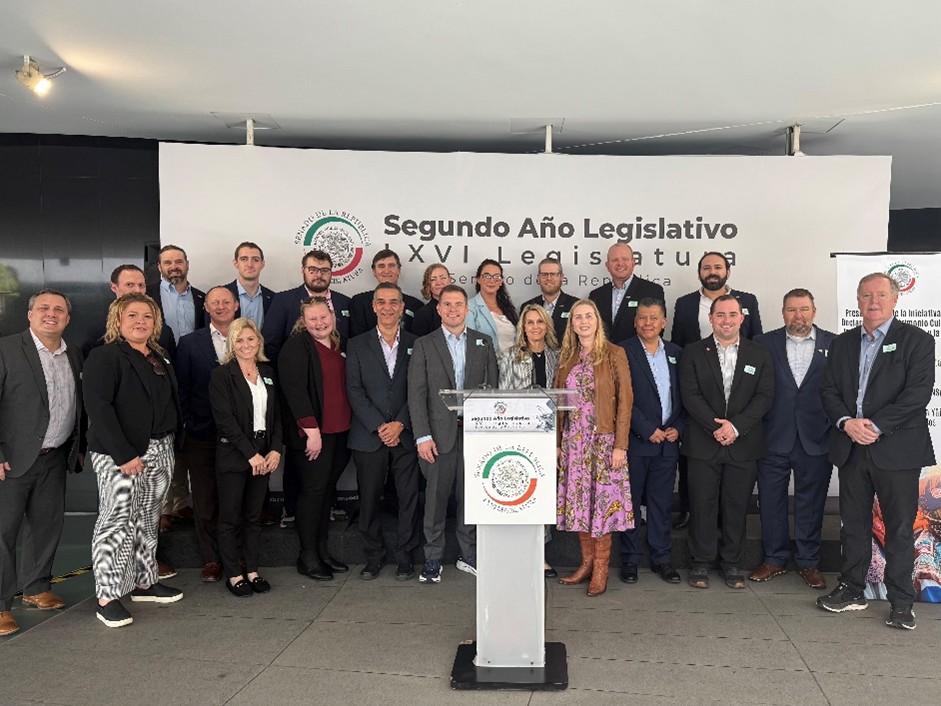
PLI class participants tour the Senate of the Congress of Mexico.