

Capital Update – For the Week Ending Jan. 16, 2026
In this week’s recap from the National Pork Producers Council: Agriculture Secretary Rollins visits with Pennsylvania pork producers; congressional agriculture leaders agree on advancing workforce, farm bill in 2026; Trump administration says California Proposition 12 is a war on farmers, consumer choice; Waters Advocacy Coalition supports new WOTUS Rule; U.S. House approves AGOA renewal; and NPPC comments on strategies for reducing Salmonella. Take a deeper dive below.

Listen to the Capital Update Here!
Agriculture Secretary Rollins Visits with Pennsylvania Pork Producers
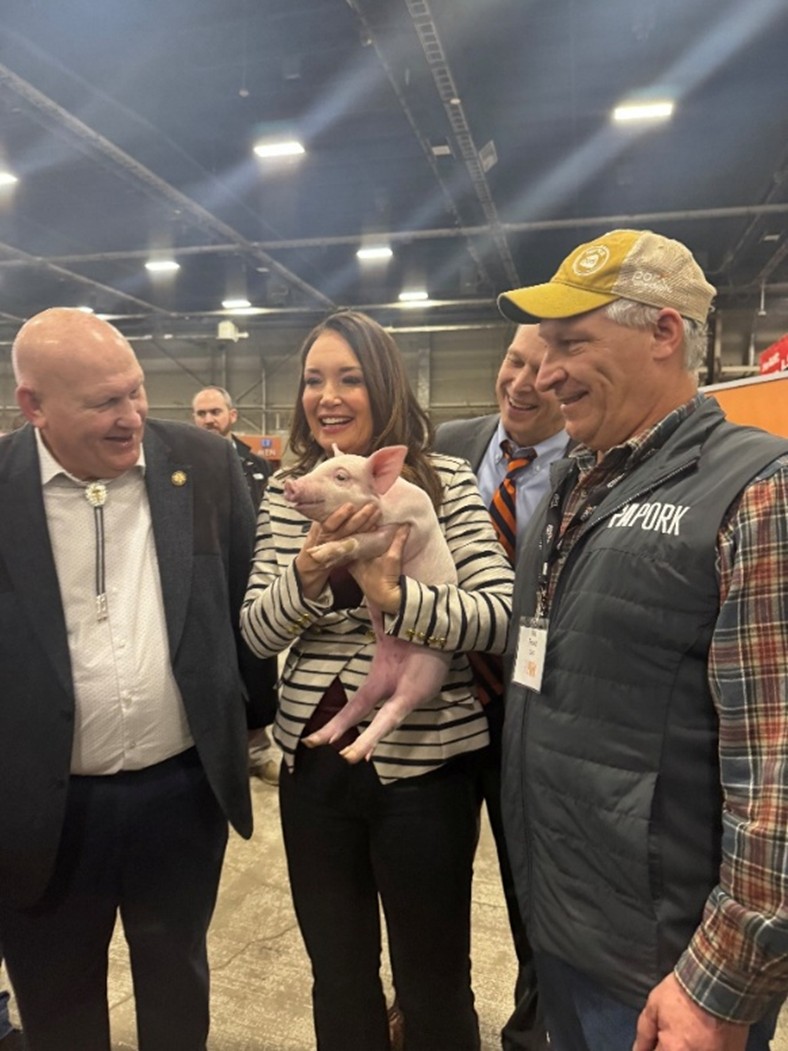
What happened: Pennsylvania pork producers met with U.S. Secretary of Agriculture Brooke Rollins at the Pennsylvania Farm Show. While discussing pork priorities, producers thanked Rollins for her leadership on the 2025-2030 Dietary Guidelines for Americans, which put pork back on breakfast, lunch, and dinner plates.
Secretary Rollins was accompanied by Centers for Medicare & Medicaid Services Administrator Dr. Mehmet Oz, House Agriculture Committee Chairman Glenn “GT” Thompson (R-PA), and Rep. Scott Perry (R-PA).
While back in his home state, Chairman Thompson also reiterated his commitment to finding a solution to the massive problems caused by California Proposition 12. More on that below.
NPPC’s take: NPPC looks forward to continuing to work with Secretary Rollins to advance and implement pork industry priorities, including the upcoming farm bill, the Trump administration’s Make America Healthy agenda, and more.
Left to right: Chairman Thompson, Secretary Rollins, and Pennsylvania pork producer Matt Brandt.
Congressional Agriculture Leaders Agree on Advancing Workforce, Farm Bill in 2026
What happened: As the second half of the 119th Congress gets into full swing, lawmakers are looking to act on a number of priorities, including passage of a fiscal 2026 funding bill and a new farm bill.
The 2026 fiscal year started Oct. 1, 2025, and the government currently is operating through January under a continuing resolution.
Farm bills govern agricultural and food policy and are typically in place for five years. However, the 2018 Farm Bill expired in Sept. 2023 and subsequently has been extended several times.
Speaking recently at the American Farm Bureau Federation annual convention, House Agriculture Committee Chairman Glenn “GT” Thompson (R-PA) said his committee likely will consider a new farm bill markup in late February. Likewise, Sen. John Boozman (R-AR), chairman of the Senate Committee on Agriculture, Nutrition and Forestry, indicated farm legislation will get done this year.
It is unclear whether the farm bill will include a fix to California Proposition 12, which bans the sale in that state of pork from hogs born to sows raised anywhere in housing that does not meet California’s arbitrary standards. Thompson said he supports inclusion of a fix, meanwhile Boozman highlighted concerns that inclusion would divide Senate lawmakers, making it harder to pass a bill.
Agriculture Committee leaders also agreed that agriculture’s workforce shortage should be addressed by reforming immigration laws. Current law allows such laborers only for temporary and seasonal farm work. Based on recommendations from the bipartisan Agriculture Labor Working Group, with which NPPC worked closely, Thompson is expected to introduce legislation that includes reform to the H-2A visa program for immigrant farmworkers in the first quarter of this year.
In related news, a lawsuit was filed in the United States District Court Eastern District of California Fresno Division following the U.S. Department of Labor’s publication of the interim final rule, which modified the methodology for calculating the hourly adverse effect wage rate for H-2A nonimmigrant workers. NPPC is monitoring the litigation and will keep members updated.
NPPC’s take: NPPC supports quick passage of a new farm bill that fixes the problems caused by Proposition 12.
NPPC continues to advocate for the year-round needs for labor in the pork industry. Statutory reform to the H-2A program would allow producers to better utilize the program to continue to supply consumers with affordable and nutritious pork.
Trump Administration: California Proposition 12 is a War on Farmers, Consumer Choice
What happened: The Trump administration remains critical of California Proposition 12, which among other concerns sets up a potential patchwork of differing state laws for sow housing that would be unworkable for producers and costly for both producers and consumers.
At the American Farm Bureau Federation annual convention in Anaheim, California, Agriculture Secretary Brooke Rollins took aim at the ballot initiative, which was approved in 2018 and became effective for pork (it also applies to eggs and veal) in July 2023.
“California, not surprisingly, has gone rogue and caused real pain to consumers and to our farmers under its poor confinement restrictions and cage-free egg commitments,” said Rollins. “This war against consumer choice and against our farmers forces Californians and those who receive those goods across the country to buy more expensive eggs and pork. California’s actions under Proposition 12 fly in the face of federal jurisdiction and regulation over food production and safety.
“It’s one thing if California passes laws that affect only its own state, but it’s another when those laws affect other states in violation of our Constitution,” she added.
In early July 2025, the administration filed a lawsuit against California to stop enforcement of the law, particularly because of its negative effects on egg prices. NPPC and AFBF challenged Proposition 12 up to the U.S. Supreme Court, which in May 2023 by a 5-4 ruling let the initiative stand.
NPPC’s take: NPPC, which has led the fight against Proposition 12 since before its passage, supports congressional efforts to address the threats – potential animal welfare issues, higher pork prices, and a rise in industry consolidation – the initiative imposes on the U.S. pork industry, including the web of state regulations it invites. NPPC is urging lawmakers to include a fix to Proposition 12 in the next farm bill.
Why it matters: Pork producers across the country must comply with Prop. 12 or forgo selling into the California market of 40 million people, who consume about 13% of all pork sold domestically. Most producers, particularly smaller ones, cannot afford the hundreds of thousands of dollars it costs to retrofit existing or build new housing that complies with Prop. 12. The negative effects of Prop. 12 would be compounded if other states were to adopt similar restrictive laws and regulations.
Waters Advocacy Coalition Supports New WOTUS Rule
What happened: NPPC, as part of the Waters Advocacy Coalition, submitted comments to the U.S. Environmental Protection Agency, voicing its support for the agency’s proposal to finally define what constitutes Waters of the United States. The proposed EPA regulation is a revision in the decades-long fight over defining WOTUS, which sets forth the jurisdiction of federal regulatory authority under the Clean Water Act. These proposed revisions come following the U.S. Supreme Court decision in Sackett v. EPA, which brought significant legal clarity to what is and isn’t WOTUS.
The new rule, according to WAC, “better aligns the regulatory definition of WOTUS with the CWA [(Clean Water Act)] and Supreme Court precedent – in particular, by defining critical terms such as ‘relatively permanent’ and ‘continuous surface connection.’
“These new definitions provide much-needed clarity and transparency, and they better preserve the states’ primary role in regulating water resources and land use within their boundaries, while still maintaining important protections for aquatic resources consistent with the law.”
The U.S. Supreme Court in May 2023 limited EPA’s authority over waterways, holding that CWA waters “refers only to geographical features that are described in ordinary parlance as streams, oceans, rivers and lakes and to adjacent wetlands that are indistinguishable from those bodies of water due to a continuous surface connection.”
Despite that decision, the Biden administration wrote a WOTUS rule that had jurisdictional categories, including drains, ditches, stock ponds, and low spots on farmlands, outside the high court’s definition and included language that made the regulation overly broad, according to comments WAC submitted on that rule.
In its comments on the updated definition of WOTUS, the WAC concluded that the rule will “provide regulatory certainty that WAC members desperately need and hopefully break the cycle of regulatory revisions with each change in administration.”
Why it matters: The WOTUS rule spells out the limits of federal jurisdiction over waterways and wetlands under the CWA. For pork producers, an expansive definition of WOTUS that included farm fields and ditches would have led to significant increases in regulatory and activist pressure and taken away the freedom of farmers to operate.
U.S. House Approves Renewal of AGOA
What happened: The U.S. House overwhelmingly approved renewal of the African Growth and Opportunity Act, which gives sub-Saharan African nations duty-free access for goods exported to the United States in exchange for “reasonable and equitable” treatment of U.S. imports. Passed on a 340 to 54 vote, the “AGOA Extension Act” now goes to the Senate for consideration. House lawmakers renewed the trade program, which expired in Sept. 2025, through 2028.
Several AGOA beneficiary countries have barriers to their markets for U.S. pork, as well as a variety of American goods and services, including Angola, Cote d’Ivoire, Kenya, Nigeria, and South Africa. The latter two have de facto bans on U.S. pork imports, for example.
Nigeria, the second-largest AGOA beneficiary, maintains a prohibition against the importation of raw pork, as well as other meats and associated products, a restriction that is not science-based and violates the General Agreement on Tariffs and Trade.
South Africa, the largest non-oil beneficiary of AGOA, has several unwarranted, non-scientific provisions that limit imports of U.S. pork, including ones that ban pork offal and restrict pork because of Porcine Reproductive and Respiratory Syndrome—despite no documented case of PRRS transmission to domestic livestock through imported pork.
NPPC’s take: While NPPC supports renewal of AGOA, it has urged the Trump administration to withhold or limit benefits for countries that have barriers to U.S. goods and services. In the past, it has supported removing Nigeria and South Africa from the AGOA program until they allow full market access for U.S. pork.
Why it matters: The objectives of AGOA are to expand U.S. trade and investment with sub-Saharan Africa, stimulate economic growth in the region, and facilitate African nations’ integration into the global economy. In many AGOA countries, pork is an important source of protein, making them potentially significant markets for U.S. pork.
NPPC Comments on Strategies for Reducing Salmonella
What happened: At a public hearing, NPPC’s Dr. Ashley Johnson, director of food policy, presented comments on strategies from the U.S. Department of Agriculture’s Food Safety and Inspection Service for addressing Salmonella in raw poultry products.
The hearing came after FSIS in May withdrew a framework proposal that would have classified certain Salmonella levels and serotypes in raw poultry products as adulterants, thereby prohibiting the products from entering the food supply. The bacterium occurs naturally and is not an “added” substance.
NPPC raised concerns about the scientific validity and practicality of protecting public health under that earlier proposal, which also could have been used as a template for dealing with Salmonella in pork products.
NPPC’s take: In her comments, NPPC’s Johnson pointed out that Salmonella is a complex bacterium, noting that preharvest tools, including vaccines, can mitigate levels of it on farm but may not translate to packing plants, where stress from transporting, receiving, and comingling animals can raise Salmonella levels.
Additionally, Salmonella serotypes found on farms do not always correlate with ones found in establishments. She called for more research to understand Salmonella preharvest interventions that can make positive impacts on food safety outcomes.
Johnson also urged FSIS to stick with performance standards as the strategy for reducing Salmonella prevalence in poultry and pork. Such standards already have proved effective, she said.
Why it matters: Salmonella control and reduction is a high priority for the U.S. pork industry. Producers and processors implement intervention strategies and are always looking for improvements to address concerns with Salmonella.