

Capital Update – For the Week Ending March 27, 2026
In the weekly recap from the National Pork Producers Council: NPPC board participates in White House Celebration of Agriculture; economic report on U.S. agriculture released; and USTR has more reforms for WTO. Find out more below.

Listen to the Capital Update Here!
NPPC Board Participates in White House Celebration of Agriculture
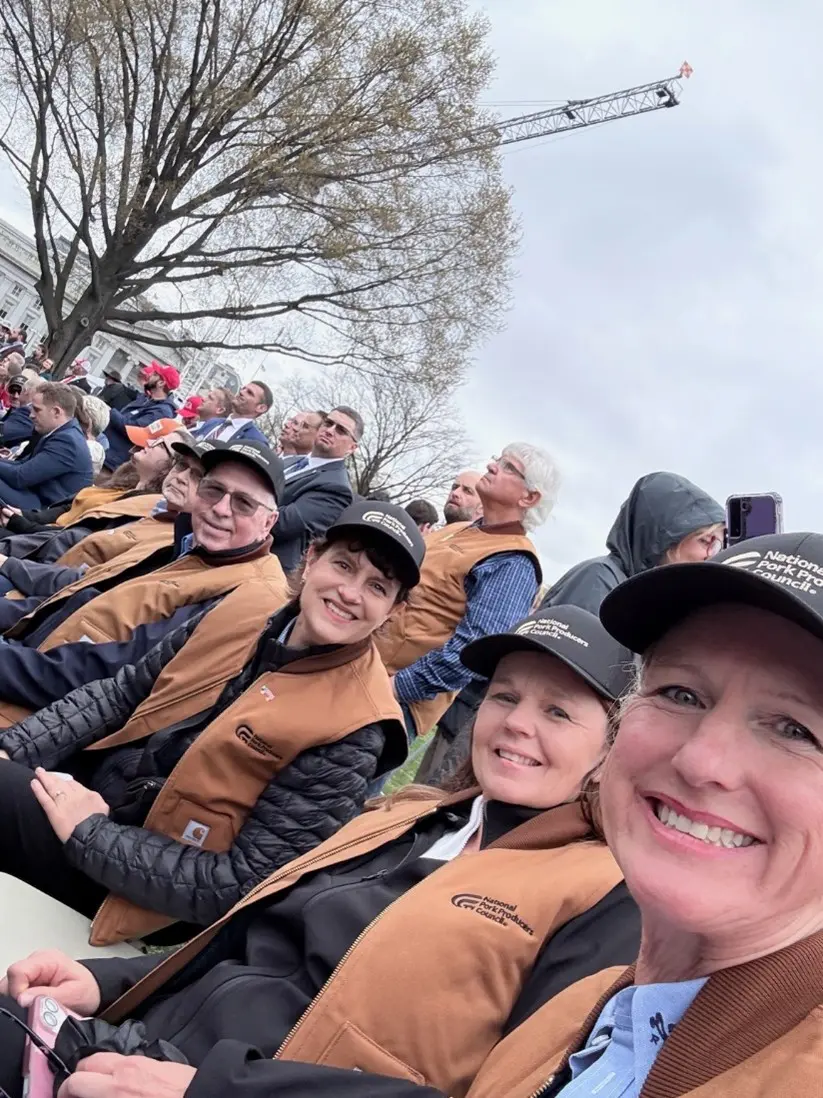
What’s happening: NPPC’s board of directors attended the White House’s Celebration of Agriculture, where President Trump recognized the efforts of America’s farmers and shone a spotlight on those who produce the nation’s food, fiber, and fuel. Trump twice in the past week – once in a Truth Social post and again at the White House event – urged Congress to pass the farm bill.
Earlier in the week, Iowa pork producer and NPPC President Rob Brenneman took part in a National Agriculture Day producer panel hosted by the National Agri-Marketing Association at the USDA headquarters. While there, Brenneman spoke with RFD Radio about pork’s needs and visited with Deputy Secretary of Agriculture Stephen Vaden, who has been a fierce advocate in the fight against California Proposition 12.
In preparation for the Farm Bill 2.0 passage, Brenneman and NPPC board members spent time on Capitol Hill, meeting with House and Senate offices and committees on both sides of the aisle. They also advocated for renewal of the United States-Mexico-Canada Agreement, a year-round solution to the H-2A visa program, and appropriations requests that would benefit pork producers.
While in D.C., the NPPC president also met with Shigeo Yamada, Japan’s ambassador to the United States, at his residence in Washington.
Why it matters: National Agriculture Day, which is hosted by the Agriculture Council of America and sponsored by dozens of agricultural groups, including NPPC, helps increase public awareness of agriculture’s vital role in American society. The event also serves as a platform for educating government officials and congressional lawmakers about issues of importance to the U.S. agriculture industry. For more information about Ag Day, click here.
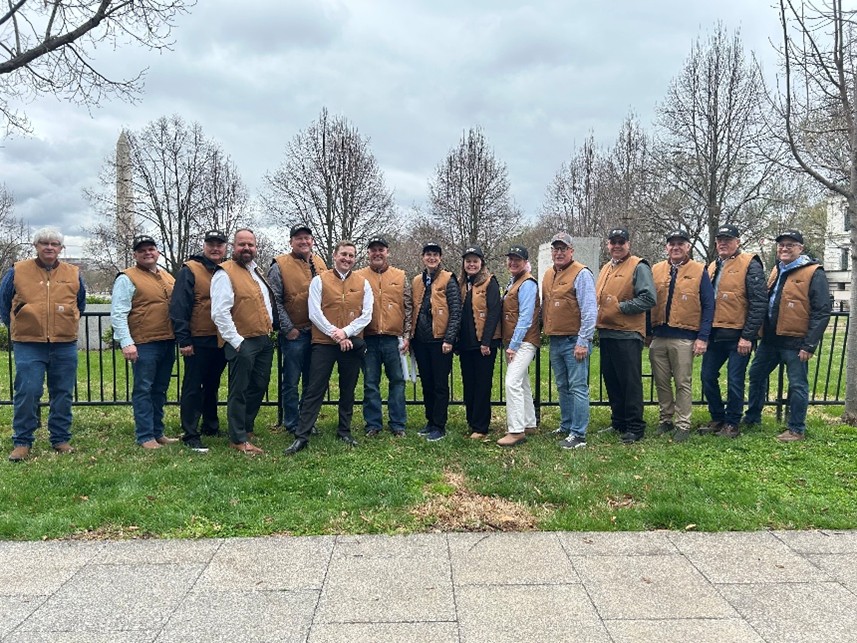
Pork producers from across the country attend the White House’s Celebration of Agriculture.
Pork producers celebrate agriculture at the White House. Left to right, in vests: Nebraska pork producer Leo Hanson, NPPC Immediate Past President and Ohio pork producer Duane Stateler, NPPC Past President and Minnesota pork producer Lori Stevermer, Iowa pork producer Trish Cook, and Indiana pork producer Jackie Bowman Ponder. Back row, in vest, is Missouri pork producer Bob North.
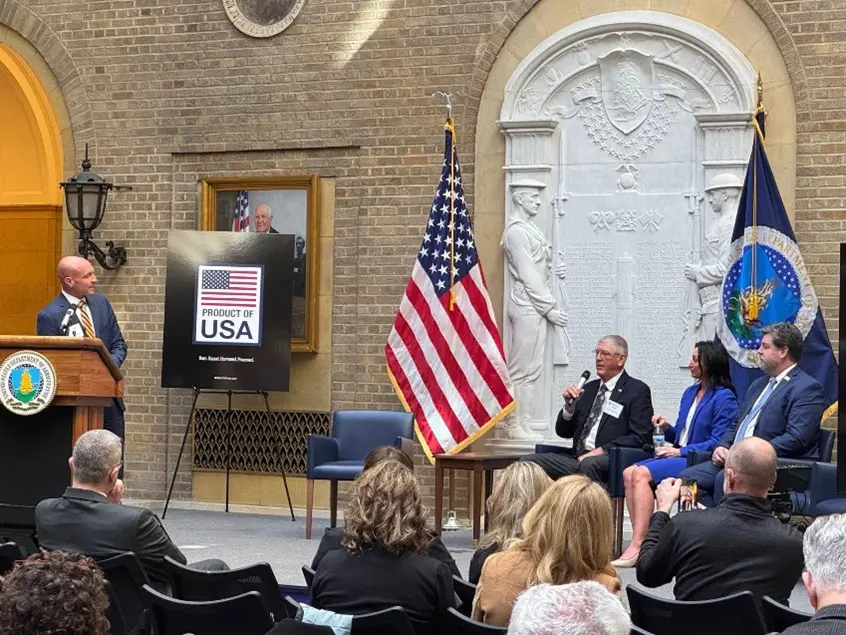
NPPC President Rob Brenneman (holding microphone) discusses the future of agriculture with National Association of Wheat Growers President Jaime Kress and American Soybean Association Vice President Dave Walton. The Ag Day panel was moderated by This Week in Agribusiness’ Mike Pearson (far left).
NPPC President Rob Brenneman (left) visits with Deputy Secretary of Agriculture Stephen Vaden on National Ag Day at USDA headquarters.

Economic Report on U.S. Agriculture Released
What happened: The U.S. agricultural industry grew by nearly $900 billion over the past year, according to an economic impact study led each year by the Corn Refiners Association and sponsored by three dozen agriculture and food organizations, including NPPC.
The 2026 Food and Agriculture Industries Economic Impact Study report shows the American food industry – farmers, ranchers, processors, manufacturers, wholesalers, retailers, and indirect businesses such as suppliers and transporters – supported almost 49 million jobs and generated more than $10 trillion in economic activity, accounting for nearly 20% of total U.S. economic output.
The 10th annual Feeding the Economy Report includes a state-by-state breakdown of agriculture’s economic impact, showing total jobs, wages, output, taxes, and exports. Key findings include:
- Food and agriculture generated more than $3 trillion in wages for U.S. workers, with wages rising 4% year-over-year and 13% over the past decade.
- Food manufacturing remains the largest manufacturing sector in the United States, employing almost 2.3 million workers.
- U.S. food and agriculture exports were more than $177 billion, though exports declined by $5.4 billion year-over-year, underscoring the need for maintaining strong trade agreements and expanding market access for American products.
- The food and agriculture sector produced $1.35 trillion in tax revenue for federal, state, and local governments, a 7% increase year-over-year.
Why it matters: The report confirms “the incredible, positive impacts of agriculture on our country,” said NPPC CEO Bryan Humphreys. “America’s 60,000-plus pork producers are proud to help drive this force that provides our food and other agriculture products—and the opportunity to be part of something bigger than themselves by carrying on a tradition of taking care of their families, neighbors, animals and land, and at heart, a way of living that often has been passed down for generations.”
U.S. pork producers annually generate more than $37 billion in personal income, contribute more than $62 billion in GDP, and support more than 573,000 jobs in the U.S. economy.
USTR Has More Reforms for WTO
What happened: The Office of the U.S. Trade Representative submitted to the World Trade Organization additional comments on reforms to the international trade body. USTR’s follow-up to a December 2025 report to the WTO was transmitted a month after the U.S. Agriculture Coalition for WTO Reform, of which NPPC is a member, sent a list of recommended WTO improvements to the U.S. trade agency.
Talks on reforming the 30-year-old WTO started during the first term of President Trump, who has been critical of some aspects of the trade organization.
The latest report also came just days before the 14th WTO Ministerial Conference in Yaoundé, Cameroon, and raised additional issues USTR wants discussed as part of the WTO reform process: application of the Most Favored Nation principle, which calls for equal treatment for MFN countries; clarification of the WTO secretariat’s role; and essential security measures, which are designed to balance a country’s national security with international trade. The December report addressed decision making; special and differential treatment for developing countries; and level playing field – ensuring fair competition among countries by applying trade rules equally, addressing subsidies, state-owned enterprises, and non-market practices.
Among other suggestions, USTR recommended the WTO:
- Level the international trade playing field by significantly strengthening incentives to comply with existing obligations to submit notifications of trade rules.
- Restore the purpose of the special and differential treatment provision by agreeing to objective criteria for determining a country’s eligibility for it.
- Rethink how the MFN principle functions in its current form and begin discussions on the link between MFN and reciprocity, “a bedrock WTO founding principle.”
Why it matters: U.S. Trade Representative Jamieson Greer has called the current global order in international trade “untenable and unsustainable.”
Currently made up of 166 member countries, the WTO deals with the rules of trade between nations. Its goal is to ensure trade flows as smoothly and predictably as possible. NPPC and other agricultural organizations have made it clear that U.S. engagement with and leadership in the WTO are essential.