

Capital Update – For the Week Ending May 1, 2026
In the weekly recap from the National Pork Producers Council: House passes farm bill with Prop. 12 fix with bipartisan support; appropriations bill would fund swine health improvement plan; NPPC wants approval of technology to combat NWS; bill to improve coordination on animal disease outbreaks introduced; and NPPC’s Marotz, Johnson attend NAFB’s Washington Watch. Find out more below.

Listen to the Capital Update Here!
House Passes Farm Bill with Prop. 12 Fix with Bipartisan Support
What happened: With an impressive, bipartisan 224-200 vote in the U.S. House of Representatives, the 2026 Farm Bill included 100% of the National Pork Producers Council’s policy requests—including much-needed relief from the misguided California Proposition 12.
In addition to a Prop. 12 fix, the farm bill also accomplished all additional NPPC priorities, including:
- Funding and converting the Feral Swine Eradication and Control Pilot Program into a full program.
- Increasing funding for critical agricultural trade promotion programs, including the Market Access Program, Foreign Market Development Program, E. Kika de la Garza Emerging Markets Program, Technical Assistance for Specialty Crops, and Priority Trade Fund.
- Requiring USDA to report how changes to or expiration of the U.S.-Mexico-Canada Agreement will affect agriculture.
- Establishing the Agricultural Trade Enforcement Task Force to better identify and overcome trade barriers.
- Expanding the Animal Health Protection Act to include improving animal disease traceability.
- Allowing the establishment of additional training centers and programs under the Beagle Brigade Act.
- Requiring thorough documentation on USDA’s ability to protect producers from significant economic losses due to a foreign animal disease outbreak.
- Capping administrative expenses for the National Animal Disease Preparedness and Response Program and the National Animal Health Laboratory Network, allowing a higher percentage of funds to be used for research.
- Requiring USDA to conduct research and development on a policy to insure pork producers against financial losses from a catastrophic disease.
NPPC and its members have long – and loudly! – advocated for a Prop. 12 fix, including recent grassroots and concerted coalition efforts to get a fix in the House Farm Bill.
NPPC, the American Farm Bureau Federation, and nearly 400 other agricultural organizations representing millions of members, urged lawmakers to fix Prop. 12 in the farm bill. In the letter to Speaker of the House Mike Johnson (R-LA) and Minority Leader Hakeem Jeffries (D-NY), the farm coalition detailed the Prop. 12 problems, including its potential to prompt a patchwork of differing state laws, failure to improve animal well-being, detrimental effect on food prices, and the costs of complying with the initiative.
The farm groups also pointed out that there has been bipartisan support for fixing Prop. 12, with Trump administration Agriculture Secretary Brooke Rollins and Biden Agriculture Secretary Tom Vilsack calling on Congress to take action.
NPPC also joined the Farm Credit Council and 330+ national and state groups in urging Congress to pass the farm bill.
NPPC’s take: “Today’s House farm bill passage is a testament to the power of rural America when we stand up for our farms and future generations with a unified voice,” said Rob Brenneman, NPPC president and pork producer from Washington County, Iowa. “We wholeheartedly thank our champions—House Agriculture Committee Chairman GT Thompson, Rep. Ashley Hinson, and others—for not backing down from the fight for what is right for rural America. He and congressional supporters on both sides of the aisle heard our plea to help America’s pork producers. Now, we look to the Senate to follow suit and pass this farm bill for us and others in agriculture without delay.”
Why it matters: The Prop. 12 provision in the 2026 House Farm Bill protects producers’ freedom to farm while allowing states to approve laws that regulate agricultural practices and impact commerce within their borders.
Without Prop. 12 relief in the final farm bill, pork producers face a patchwork of state animal housing laws that hurts small farmers the hardest, takes away veterinarians’ choices, increases the cost of food, and undermines states’ rights.
Appropriations Bill Would Fund Swine Health Improvement Plan
What happened: The House Committee on Appropriations approved fiscal year 2027 funding for programs related to the U.S. Department of Agriculture, the Food and Drug Administration, and related agencies. Included was the NPPC-backed, cooperative state-federal-industry program, the U.S. Swine Health Improvement Plan, which helps improve the health and marketability of U.S. swine and pork products.
US SHIP sets consistent biosecurity, traceability and surveillance standards for foreign animal diseases and endemic diseases. Participants work to obtain certification that they are free from FADs, outside control areas, and in the case of endemic diseases, a certification declaring a specific health status.
NPPC’s take: NPPC applauds the House Committee on Appropriation’s passage of the agriculture spending bill, which also increases funds for agricultural research and USDA’s Food Safety and Inspection Service and maintains funds for agricultural trade programs.
NPPC continues to urge USDA to establish the federal advisory committee so that producers can be involved in setting the program’s standards and carry that message forward to USDA.
Why it matters: US SHIP is an important tool for demonstrating that pork operations are free of disease, which can expedite the resumption of trade following an FAD outbreak. An FAD outbreak in the United States could stop pork exports for more than 10 years at a cost of $50 billion, according to estimates from Iowa State University economists. For more information on US SHIP, click here.
NPPC Supports Approval of Technology to Combat NWS
What happened: In comments to the U.S. Environmental Protection Agency, NPPC asked to give “full and timely consideration” for approval of new technology to help prevent New World screwworm.
NWS is a flesh-eating parasite from female flies that lay eggs in wounds on warm-blooded animals. Animals that recently have given birth, suffered an injury, or had a surgical procedure, such as tail docking or branding, are most vulnerable.
The U.S. Department of Agriculture’s Agricultural Research Service recently applied to register NovoFly – a technology incorporating a genetically engineered female-lethal trait that results in male-only sterile flies – for use in combatting NWS.
NPPC in its comments noted that many chemical treatments to manage screwworm infestations no longer are widely available or practical for large-scale prevention. NovoFly, it said, provides a targeted, species-specific, and environmentally responsible alternative that aligns with modern integrated pest management principles.
Approving ARS’s application for NovoFly, NPPC said, “will help ensure that the United States remains prepared to prevent the reintroduction and spread of New World screwworm, protecting animal health, agricultural producers, and the broader economy.”
Why it matters: The introduction of a pest such as NWS into the United States, if not addressed quickly, would result in immediate animal and human health risks and implications that would affect significant portions of the U.S. economy and food supply security.
Bill to Improve Coordination on Animal Disease Outbreaks Introduced
What happened: Sen. Tammy Baldwin introduced the “Wildlife Health Coordination and Zoonotic Disease Prevention Act of 2026,” a bill to increase interagency coordination during wildlife, livestock, and domestic animal disease outbreaks.
The bill will create a program administered jointly by the U.S. Department of Agriculture’s Animal and Plant Health Inspection Service and the Department of the Interior’s U.S. Fish and Wildlife Service.
The bill would establish a national wildlife health coordinator, a tribal coordinator, and four regional coordinators to help increase communication among agencies on the frontlines of animal and human health. They would share information on existing and emerging wildlife and zoonotic disease outbreaks with states, the National Animal Health Laboratory Network, USDA, FWS, and the Centers for Disease Control and Prevention.
NPPC’s take: NPPC and the Wisconsin Pork Producers Association support the Baldwin’s bill as a step toward stronger coordination among animal health, wildlife, and public health agencies. By enhancing communication and resources across federal, state, and tribal partners, the legislation will help protect livestock, safeguard producers, and reduce the risk of zoonotic disease outbreaks affecting the food system. NPPC and Wisconsin Pork supported similar legislation in 2024.
Why it matters: Preventing and responding to animal disease outbreaks is essential to the viability of animal agriculture, and improving coordination of efforts among federal and state entities responsible for animal and human health will help ensure outbreaks are addressed efficiently and quickly, minimizing their effects on producers, animals, and consumers.
NPPC’s Marotz, Johnson Attend NAFB’s Washington Watch
What happened: NPPC Vice President Todd Marotz, who is chief production officer for Wakefield Pork in Sleepy Eye, Minnesota, and NPPC Director of Food Policy Dr. Ashley Johnson participated in the National Association of Farm Broadcasting’s annual Washington Watch issues forum in Washington, DC, conducting 15 radio interviews, reaching nearly 1,000 network affiliates.
Among the topics they discussed were:
- A legislative fix to California’s Proposition 12, which bans in that state the sale of pork from hogs born to sows raised in housing that fails to meet California’s standards.
- The new farm bill, which includes a Prop. 12 fix as well as reauthorization of programs to prevent and prepare for foreign animal diseases and to promote agricultural exports.
- Animal health issues such as preventing and preparing for an outbreak of New World screwworm and funding for the U.S. Swine Health Improvement Plan, a cooperative state-federal-industry program designed to improve the health and marketability of U.S. swine and pork products.
- The farm labor shortage and reform of H-2A visas to make them more useful to animal agriculture. Currently, H-2A visas only allow temporary, seasonal farm workers into the country; producers need year-round employees.
- Additional trade agreements to open markets to more U.S. farm goods, including pork, and the need to extend the United States-Mexico-Canada Agreement, which the three signatory countries will begin reviewing starting in July.
Why it matters: NAFB’s Washington Watch connects agriculture broadcasters and agricultural industry leaders to discuss key issues affecting U.S. farmers. Farm broadcasters are a trusted source, provide an invaluable service, and are a vital tool for communicating with the agricultural community, telling the story of the who, what, when, where, and how of America’s food, feed, fiber, and fuel system.
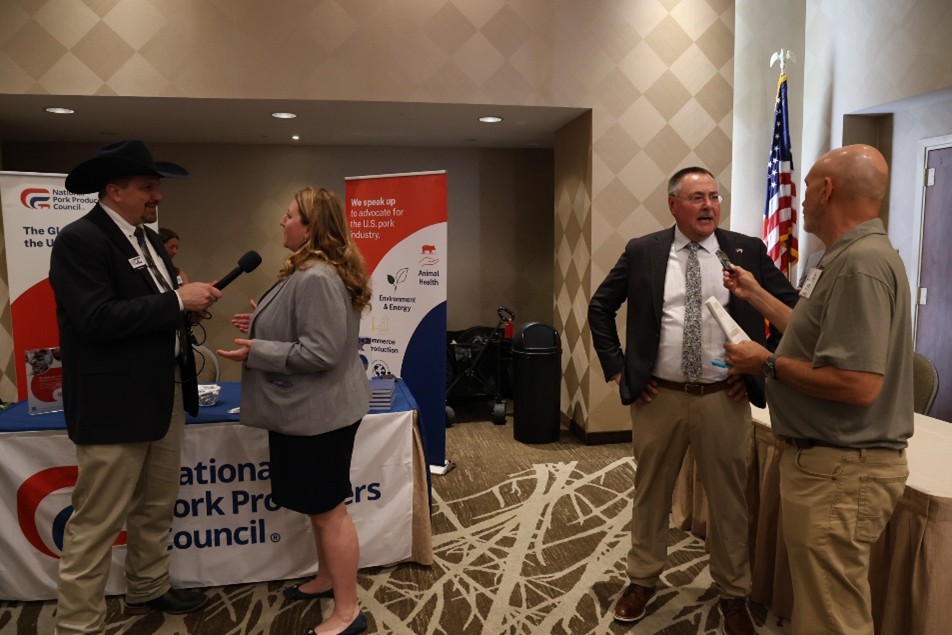
NPPC Vice President Todd Marotz (second from right) is interviewed by NAFB’s Mike Davis while NPPC Director of Food Policy Dr. Ashley Johnson (second from left) is interviewed by Northern Ag Network’s Andy Schwab.