

Capital Update – For the Week Ending August 8, 2025
In the National Pork Producers Council’s weekly recap: District court upholds air reporting exemptions; NPPC weighs in on upcoming MAHA strategy; Senate confirms Lindberg for top USDA trade job; USDA updates NPPC on efforts to deal with feral swine; U.S., EU reach agreement as tariffs are raised on Canadian exports; and Capital Update on modified schedule during congressional recess. Take a deeper dive below.

Listen to the Capital Update Here!
District Court Upholds Air Reporting Exemptions
What Happened: NPPC secured a significant victory in its long-running efforts to stop activists from forcing farmers to report routine emissions to state and local emergency response authorities. Ruling for the U.S. Environmental Protection Agency and the NPPC coalition of farm and livestock intervenors, the Federal District Court for the District of Columbia dismissed the challenge of activists to an earlier EPA rulemaking that exempted livestock farms from having to treat routine air emissions as emergency releases and report them to local first responders.
Why It Matters: NPPC and other livestock groups have been fighting activists over this issue since January 2009 when the Bush administration required livestock farms to file reports to emergency authorities over the routine emissions from livestock farms. The debate over these emissions dates back far earlier – to the late 1990s – when activist groups such as the Waterkeeper Alliance made them a centerpiece of its campaign against the U.S. pork industry.
Since the federal government lacked any science that would justify enforcement against livestock farms, the Clinton administration proposed an agreement to better understand air emissions. That resulted in the Air Consent Agreements that the industry signed with EPA and the start of the National Air Emissions Monitoring Study to help policymakers better understand what types of emissions came from livestock farms. Those efforts continue to this day, with comments on EPA’s latest air emission models due to the agency later this month.
In 2017, the Federal Court of Appeals for the D.C. Circuit ultimately found that reporting of routine farm emissions was required to be made to the U.S. Coast Guard under the Comprehensive Environmental Response, Compensation, and Liability Act of 1980 (CERCLA, or the Superfund law). Congress quickly passed the FARM Act with a strong bipartisan majority, which exempted livestock farms from CERCLA reporting. In implementing the statute, EPA exempted reporting to state and local first responders under the Emergency Planning and Community Right-to-Know Act (EPCRA), reasoning that reporting is only required under EPCRA when it is also required under CERCLA.
Activists, led by then-Humane Society of the United States and Food and Water Watch, filed suit, claiming EPA failed to follow EPCRA’s requirements and comply with the National Environmental Policy Act – and that Environmental Justice concerns demanded that farmers be obligated to report the information.
The District Court disagreed – agreeing with NPPC and EPA that since Congress passed the Farm Act, no reporting was necessary, making this a huge win for U.S. pork producers.
NPPC Weighs in on Upcoming MAHA Strategy
What happened: NPPC submitted recommendations to the Make America Healthy Again (MAHA) Commission on its “Make Our Children Healthy Again Strategy” that is scheduled to be released in mid-August. The comments detailed suggestions on defining “ultra-processed food,” protecting the use of certain food additives, reforming the “generally recognized as safe” standard for food ingredients, and adopting a risk-based approach – rather than a hazard-based one – for determining the safety of technologies used in food production.
Separately, joining forces with 30 additional agricultural organizations, NPPC asked the commission to accept formal public comments on its strategy.
President Trump established the commission to assess the relationship between human health and food and make recommendations related to food production. In May, the commission, whose members include U.S. Health and Human Services Secretary Robert F. Kennedy Jr., Agriculture Secretary Brooke Rollins, and Environmental Protection Agency Administrator Lee Zeldin, among others, issued an assessment critical of some farm production practices, including the use of pesticides in crop farming and animal health products in livestock and poultry production.
Why it matters: The MAHA Commission’s recommendations could make it more difficult for farmers to have access to pesticides and animal health products that have helped them produce the world’s safest, most abundant, and most affordable food. Input from farmers and ranchers would give the commission a better understanding of the farming systems and practices that American agriculture employs to deliver a safe, healthy, and affordable food supply, said the agricultural organizations in their letter.
Senate Confirms Lindberg for Top USDA Trade Job
What happened: Before adjourning for a month-long recess, the Senate approved Luke Lindberg’s nomination to be Under Secretary for Trade and Foreign Agricultural Affairs in the U.S. Department of Agriculture.
Lindberg most recently was president and CEO of South Dakota Trade, which collaborates with local and regional agriculture groups to help the state’s producers and agricultural partners navigate the global trade landscape. He also served on the board of directors of the National Association of District Export Councils and as an adviser with the U.S. Global Leadership Coalition. Lindberg was chief of staff and chief strategy officer at the U.S. Export-Import Bank during President Trump’s first term in the White House.
NPPC’s take: NPPC strongly supported Lindberg’s nomination to be USDA Under Secretary for Trade and Foreign Agricultural Affairs. It was one of 100 agriculture and food organizations signing onto a July 7 letter urging the Senate to quickly confirm him.
Why it matters: Lindberg will represent USDA in trade negotiations and will play an important role in administering the agency’s international food assistance programs and be responsible for coordinating commodity procurement among various departments within USDA.
USDA Updates NPPC on Efforts to Deal with Feral Swine
What happened: NPPC’s Animal Health Food Safety Policy Committee met in Ft. Collins, Colorado, with the U.S. Department of Agriculture’s Wildlife Services to discuss ongoing efforts to deal with feral swine.
Present in at least three-quarters of the states, feral swine damage agricultural crops and land and carry diseases that can affect people, livestock, and wildlife.
Members of the AHFSPC got updates on USDA’s feral swine management and control program, surveillance activities, how federal and state governments are working together to manage feral swine, successes of state programs, and how the detection in Hispaniola of African swine fever influenced the management of feral swine in the United States.
Other topics discussed at the meeting, included responses to a foreign swine disease in feral swine versus domestic swine, how to protect pigs with outdoor access from feral swine, funding for feral swine programs, lessons learned from other countries, and the risk posed by Canadian feral swine.
Why it matters: According to USDA, feral swine cost the country more than $2 billion annually in control efforts and damage. Additionally, given that they are present in at least 35 of the states and there are more than 7 million of them, feral swine could quickly spread foreign animal diseases, such as ASF, if there were an outbreak in the United States.
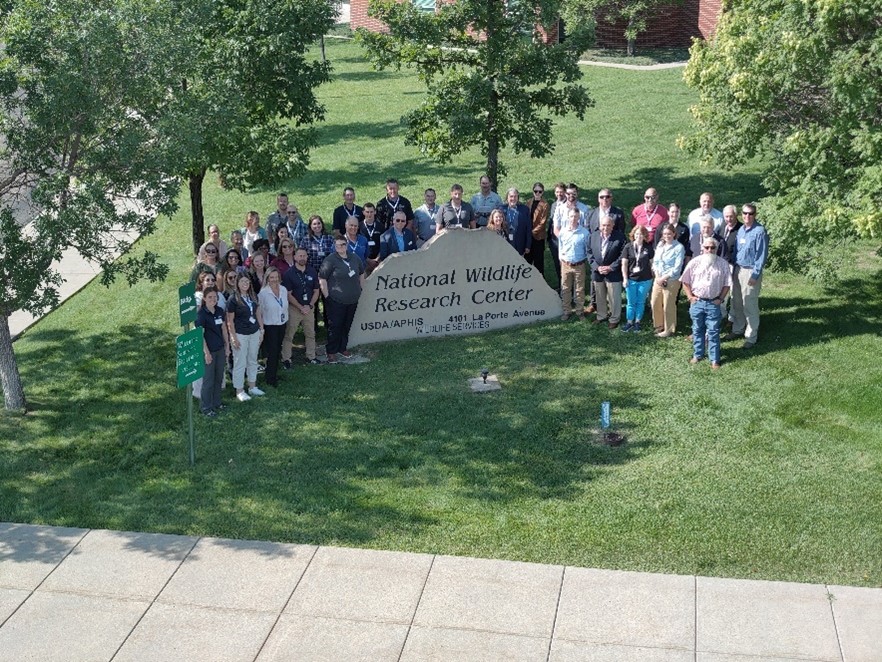
Participants of the feral swine conference at the National Wildlife Research Center in Fort Collins.
U.S., EU Reach Deal; Tariffs Raised on Canadian Exports
What happened: The Trump administration continued its venture into international trade waters, concluding a framework deal with the European Union and raising tariffs on goods from Canada over that country’s reluctance to work out an agreement with the United States.
The agreement with the EU includes a 15% tariff on products exported to the United States; the economic bloc will continue to pay a 50% duty on aluminum, copper, and steel exports. The deal also calls for the EU by 2028 to purchase $750 billion of U.S. energy and invest $600 billion in the United States.
The two sides will work to eliminate tariffs in various sectors and establish reasonable quotas for some products. The EU also will address a number of non-tariff barriers to U.S. exports, including ones affecting trade in food and agricultural goods, streamlining, for example, requirements for sanitary certificates for U.S. pork and dairy products.
For Canada, President Trump on Aug. 1 hiked the duty to 35% from 25% on Canadian goods not covered by the U.S.-Mexico-Canada Agreement. (Less than 10% of Canada’s exports aren’t covered by the USMCA). Mexico also faced an Aug. 1 deadline to work out a deal, but the president granted it a 90-day extension.
NPPC’s take: NPPC looks forward to reviewing the details of the deal. The European Union market has been virtually closed to U.S. pork. The United States exported just $12 million of pork in 2024 to the EU, the second-largest consumer of pork in the world.
NPPC will continue urging the Trump administration to reach deals with Canada, Mexico and other countries of import act to U.S. pork exports.
NPPC is closely monitoring trade negotiations and will keep members apprised as final details become available.
Why it matters: Agreements that eliminate tariffs on and non-tariff barriers to U.S. goods should boost exports of pork. The U.S. pork industry is highly dependent on exports, which in 2024 topped $8.6 billion and equated to an average of more than $66 in value from each hog marketed. Exports accounted for 25% of total production and supported more than 145,000 U.S. jobs.
Capital Update on Modified Schedule During Congressional Recess
The U.S. Senate and House of Representatives began a month-long recess. Capital Update will be issued on an as-needed basis during their break. It will resume regular publication the Friday following Labor Day.