

Capital Update – For the Week Ending Feb. 20, 2026
In the weekly recap from the National Pork Producers Council: NPPC hails proposed rule to allow faster packing plant line speeds; Thompson talks Farm Bill 2.0 with Illinois pork producers; groups support EPA rule on CWA NPDES permits; and NPPC participates in 102nd USDA Ag Outlook Forum as commodity outlooks are released. Find out more below.

Listen to the Capital Update Here!
NPPC Hails Proposed Rule to Allow Faster Packing Plant Line Speeds
What happened: The U.S. Department of Agriculture proposed a rule to update the New Swine Inspection System line speeds program to increase efficiency at pork processing plants.
The regulation will remove the maximum line speeds limit for establishments operating under the 2019 NSIS, which modernized the inspection process for pork packing plants. Participating facilities will be allowed to set their own line speeds based on a demonstrated ability to maintain process controls and food safety.
In November 2021, USDA’s Food Safety and Inspection Service allowed six pork packing plants that had adopted the NSIS to opt into Time Limited Trials to run at faster processing line speeds. They had to collect data to evaluate the impact on worker safety with increased line speeds. After a two-year trial, FSIS in November 2023 extended the trial for 90 days, then for another year.
Last January, FSIS released the results of a months-long study of increased line speeds at the six NSIS plants, concluding they “were not determined to be the leading factor in worker musculoskeletal disorder risk at these plants.” USDA announced plans to make increased line speeds permanent in March.
NPPC’s take: Since 2019, NPPC has advocated for increased line speeds under the NSIS and for elimination of limits on harvesting speeds as a way to increase packing capacity and alleviate pork supply issues.
“Thank you, Secretary Rollins and the Food Safety and Inspection Service for taking steps to unleash the potential to process pork more efficiently while also protecting food and worker safety,” said NPPC President Duane Stateler, a pork producer from McComb, Ohio. “Greater efficiency of increased line speeds provides financial security and more stability for pork producers.”
Why it matters: Ensuring sufficient harvest capacity at packing plants is critical to the ability of the U.S. pork industry to provide products to consumers worldwide. Without faster line speeds, there would be a decrease in packing capacity as more hogs chase less shackle space, which could affect pork prices. Economists estimated producers would have lost an additional $10 a head in the first half of 2024 without faster line speeds.
Thompson Talks Farm Bill 2.0 with Illinois Pork Producers
What happened: Less than a week after introducing a bill to reauthorize federal programs through the Farm Bill, House Agriculture Committee Chairman Glenn “GT” Thompson (R-PA) was touting its benefits to agriculture before pork producers at the annual meeting of the Illinois Pork Producers Association. More than 200 attended the meeting, which also saw appearances from Reps. Darin LaHood (R-IL) and Mary Miller (R-IL).
Thompson spoke about the farm provisions in the One Big, Beautiful Bill approved last Fourth of July, including its beneficial tax measures; the upcoming review of the United States-Mexico-Canada Agreement; and the need to take action to address agriculture’s labor shortage.
Thompson also previewed his Farm Bill 2.0, which includes a fix to California Proposition 12, which bans in that state the sale of pork from hogs born to sows raised anywhere in housing that fails to meet California’s arbitrary standards. Farm Bill 2.0 clarifies that states and local governments can’t impose as a condition of sale or consumption production standards on livestock unless they’re physically located in the state or locality.
NPPC’s take: NPPC supports the Farm Bill 2.0 and strongly backs inclusion of a fix to Proposition 12, which has increased pork operating costs, creating business uncertainty and raising consumer pork prices.
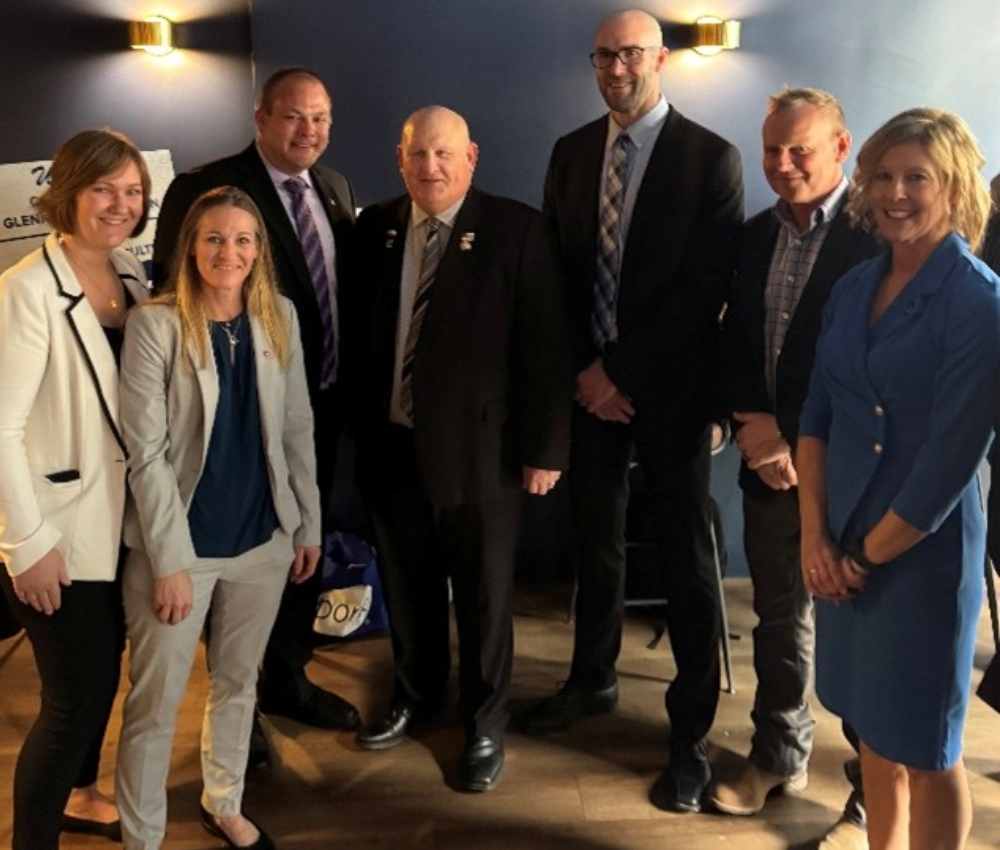
Chairman Thompson (center) meets with Illinois pork producers.
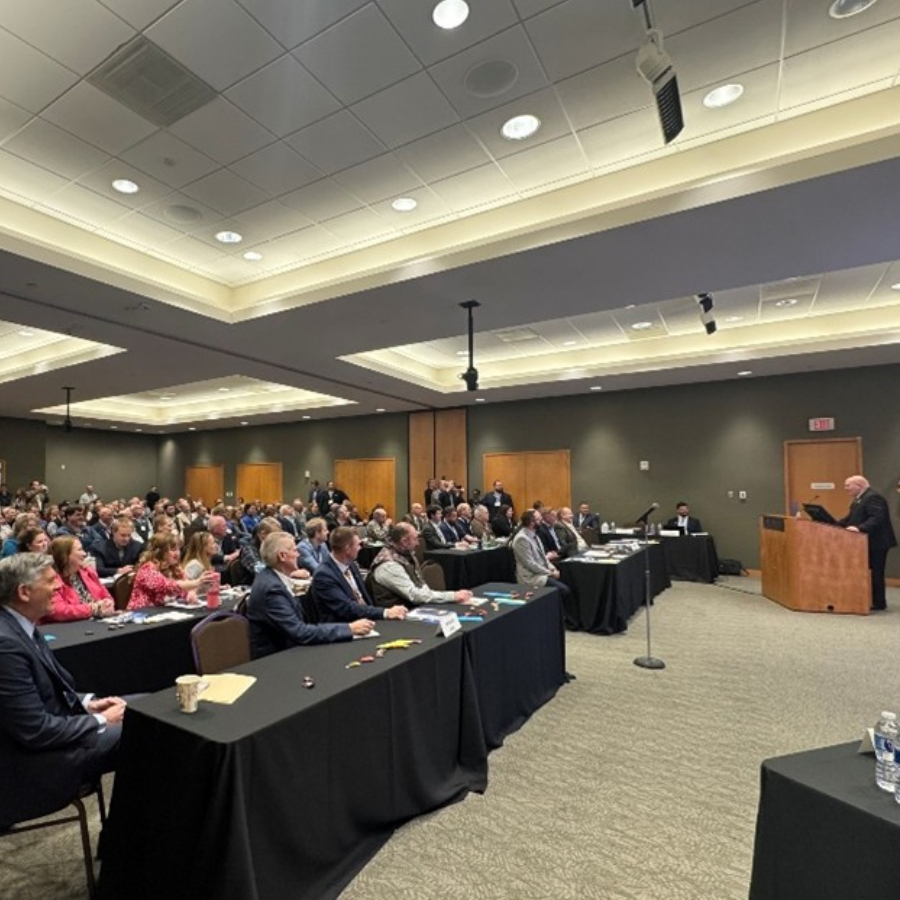
Chairman Thompson (far right) talks Farm Bill 2.0 to the Illinois Pork Producers Association annual meeting.

Left to right: Illinois pork producers Thomas Titus and Ken Maschhoff talk with Chairman Thompson.
Groups Support EPA Rule on CWA NPDES Permits
What happened: A group of 19 agriculture and business organizations, including NPPC, submitted to the U.S. Environmental Protection Agency comments in support of the agency’s proposed rule revising Clean Water Act water quality state certification requirements.
The new regulation would ensure that the CWA’s Section 401 process, which requires state certification of projects and entities, such as large livestock farms, that need National Pollutant Discharge Elimination System permits, operates within the boundaries established by Congress, maximizing permitting efficiency and eliminating unwarranted delays while maintaining the role of states (and authorized tribes) in the process.
A Biden-era regulation expanded the scope of Section 401, making it possible for states to delay issuing permits and/or impose restrictions unrelated to discharges. Activist groups also used that permitting process to unnecessarily delay or block vital energy, infrastructure, and development projects critical to America’s economic and national security, according to the agriculture and business groups.
Environmental activists, for example, wanted the city of San Francisco fined for failing to control pollutants in stormwater from getting into San Francisco Bay. The city’s NPDES permit only set pollutant levels for sewage. The U.S. Supreme Court last March ruled the CWA does not authorize EPA to include “end-result” provisions in NPDES permits, which would make permittees responsible for the quality of the water in the body of water into which they discharge.
Why it matters: Under EPA’s proposed rule, the NPDES state certification process – and the permits themselves – would focus on discharges and their direct impact on water quality and could not consider factors outside a permittees’ control.
Agricultural producers need a predictable permitting process and environmental regulations that are efficacious and cost-effective and that do not result in unnecessary delays, uncertainty, and administrative burdens that hinder agricultural production, conservation, and environmentally beneficial projects.
NPPC Participates in 102nd USDA Ag Outlook Forum as Commodity Outlooks are Released
What happened: The United States Department of Agriculture held its 102nd Ag Outlook Forum in Crystal City, Virginia, gathering industry leaders and more than 80 subject matter experts, executives, and academics to discuss topics and key issues affecting agriculture. Several members of NPPC’s Washington, DC, public policy office participated in the two-day event.
Attendees heard USDA’s initial 2026 forecast for the agricultural economy, commodity markets, trade, and farm income from Chief Economist Justin Benavidez, and there were sessions on research to help combat New World Screwworm; the outlook for livestock, poultry, and dairy; and the latest on nutrition and the Dietary Guidelines for Americans.
Agriculture Secretary Brooke Rollins delivered the keynote address, stressing important issues for the agency, including its efforts to support farmers and promote U.S. agricultural exports. She also touched on the new Farm Bill, a framework of which was introduced by U.S. House Agriculture Committee Chairman Glenn “GT” Thompson (R-PA). That bill includes a federal fix to the problems caused by the impending patchwork of state laws spurred by California Proposition 12.
The commodity outlooks released at the Ag Outlook Forum provide the first supply and demand forecasts for the 2026/2027 crop year. For corn, early forecasts show a decline in planted acres and yield, resulting in a 7% decline from the record production in 2025/26. With a slight decline in domestic use and exports, the stocks-to-use ratio is forecast 1.5% lower, supporting an increase in the season-average corn price from $4.10/bu. in 2025/26 to $4.20/bu. in 2026/27. Soybean meal production is forecast to increase 3% with prices expected to increase slightly from $295/short ton in 2025/26 to $300/short ton in 2026/27. Corn and soybean meal balance sheet forecasts will continue to be updated in the World Agriculture Supply and Demand Estimates reports later this spring.
The updated outlook for livestock showed nearly a 3% increase in pork production expected for 2026 based on expectations for improved productivity measures and heavier dressed weights. Exports are expected to increase 2% from 2025 to 2026, and annual average hog prices are forecast slightly higher. Beef production is expected to decline marginally after falling by 4% in 2025. USDA expects strong consumer demand for protein to be supportive of livestock and poultry prices in 2026.
Why it matters: The Ag Outlook Forum offers opportunities for exchanging ideas, information, and best practices among agricultural producers, processors, policymakers, government officials, and domestic and foreign non-governmental organizations.