

Capital Update – For the Week Ending April 17, 2026
In the weekly recap from the National Pork Producers Council: one hundred-plus pork producers lobby lawmakers in Washington; updated data confirm California Prop. 12 raised prices, reduced consumption; NPPC leads comments on revised USDA conservation practice standards; USDA releases updated playbook on New World Screwworm; NPPC asks Treasury to extend comments on 45Z clean fuels tax credit rule; NPPC details importance to producers of USDA data products; and USTR issues 2026 report on foreign barriers to trade. Find out more below.

Listen to the Capital Update Here!
One Hundred-plus Pork Producers Lobby Lawmakers in Washington
What happened: NPPC held its spring Legislative Action Conference, with more than 100 pork producers from 23 states in Washington, D.C., to lobby their congressional members on issues of importance to the U.S. pork industry, primarily California Proposition 12.
Before meeting with their lawmakers, producers heard a panel discussion on the 119th Congress, policy priorities, and the upcoming midterm elections from Kirsten Chadwick, a partner with Fierce Government Relations, and Anne MacMillan, chief strategy officer with public affairs firm Invariant. The talk was moderated by NPPC Vice President of Government Affairs Maria C. Zieba.
During their Capitol Hill visits, producers urged lawmakers to take action on the following issues:
- Farm Bill 2.0 – Quickly approve a new farm bill that includes a provision that fixes the problems caused by Prop. 12.
- United States-Mexico-Canada Agreement – Urge the Trump administration to maintain market access for U.S. pork during the mandatory USMCA review in July.
- U.S. Swine Health Improvement Plan – Support funding and establish a federal advisory committee for the US SHIP, which helps enhance biosecurity, advance animal traceability, and improve disease surveillance.
- Farm workforce – Expand the H-2A visa program to allow year-round agricultural workers as a way to address a farm labor shortage.
Why it matters: NPPC’s biannual legislative fly-in is an important opportunity for its pork producer members to help advance various issues of importance to the U.S. pork industry and for policymakers to learn about the many benefits the industry provides in their districts, states, and throughout the country.
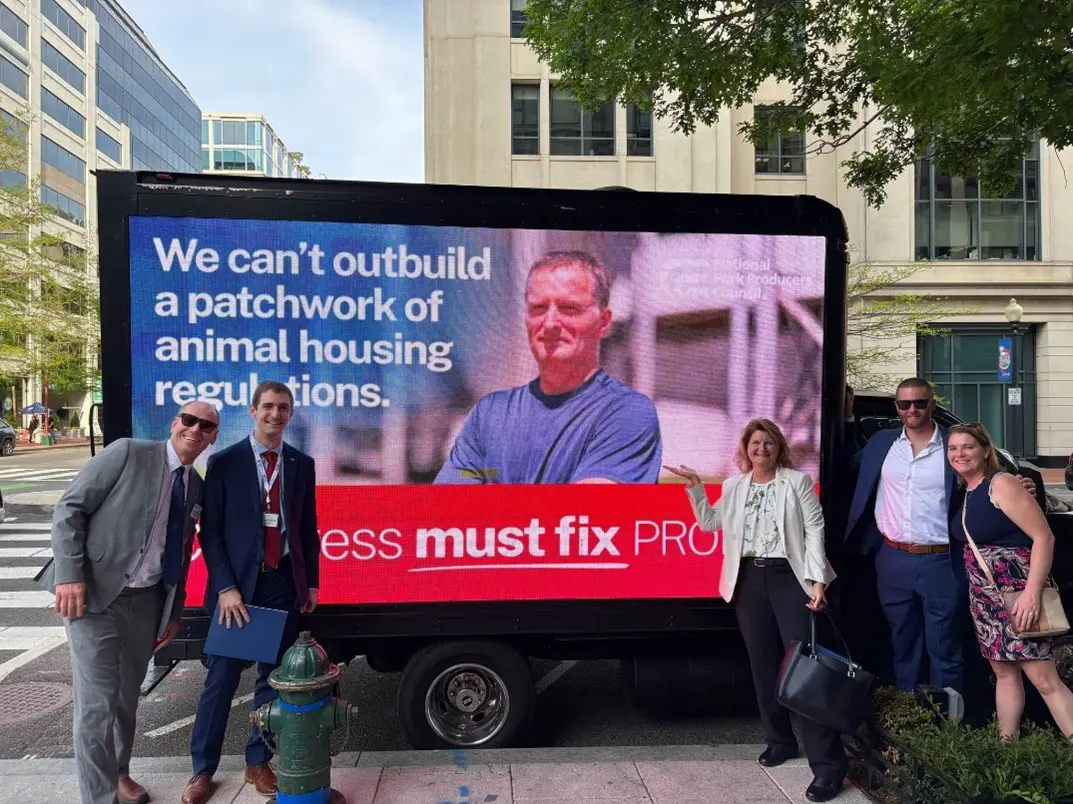
Michigan pork producers in front of the “Fix Prop. 12” mobile billboard, which traveled around Capitol Hill throughout the week and features multiple producer testimonials advocating for a Prop. 12 fix.
Pork producers from across the country listen to policy priority updates during NPPC’s Spring Legislative Action Conference.

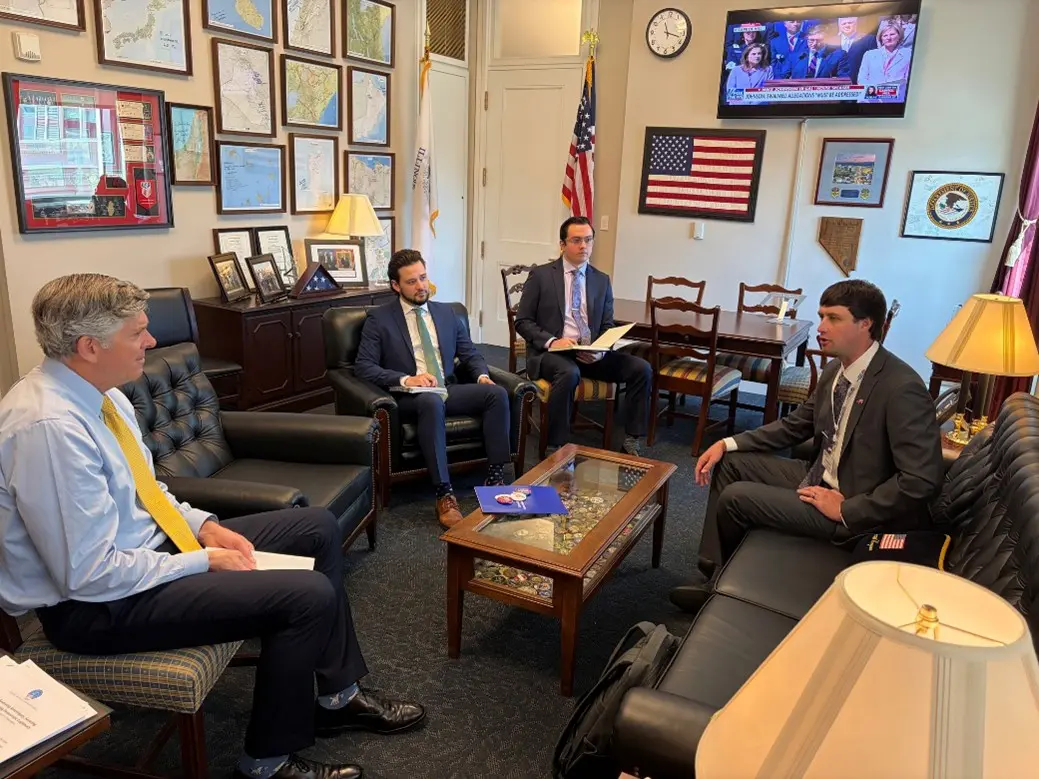
Illinois pork producers discuss Prop. 12 issues with Rep. Darin LaHood (far left).
U.S. Senate Committee on Agriculture, Nutrition, and Forestry Chairman John Boozman (R-AR) speaks with NPPC President Rob Brenneman (left) and NPPC CEO Bryan Humphreys (right).

Updated Data Confirm California Prop. 12 Raised Prices, Reduced Consumption
What happened: Updated data from researchers at North Dakota State University showed the continuing negative economic impacts of California Proposition 12, which banned the sale in California of pork from hogs born to sows raised anywhere in housing that doesn’t meet the state’s standards.
The follow-up to a July 2025 NDSU Agricultural Risk Policy Center white paper found data gathered since that earlier study shows “substantial and persistent price increases” in California for pork cuts covered by Prop. 12, with an average price 20% higher than the pre-Prop. 12 period. Prices for pork loins increased 32%, ribs 22%, shoulders 16%, and bacon 16%.
The data also showed California’s pork consumption down approximately 16%, “with no signs of recovery during the post-policy period.” Despite that drop, the state’s consumers have paid $350 million more for pork purchased since Prop. 12 was implemented on January 1, 2024.
The white paper’s authors concluded that the combination of higher prices and limited availability of pork has produced lasting structural changes in consumption in California rather than a short-term adjustment.
NPPC’s take: “We’re all singing from the same songbook – real pork producers of all sizes. We need relief from a patchwork of state animal housing laws, which will surely be the nail in the coffin for a number of farms across the country,” said NPPC President Rob Brenneman, a pork producer from Washington, Iowa.
Why it matters: Pork producers who traveled to Washington, D.C., to lobby Congress on important pork industry issues referenced the latest data in urging their congressional lawmakers to support a provision that fixes the problems caused by Prop. 12 included in the next farm bill. The House farm bill consideration may take place as soon as the week of April 27.
Coalition Comments on Revised Conservation Practice Standards
What happened: The NPPC-founded Agricultural Nutrient Policy Council, a coalition of more than 50 state and national agribusinesses and agricultural associations, submitted comments to the U.S. Department of Agriculture’s Natural Resources Conservation Service on redlined revisions to 60 of the agencies conservation practice standards. The standards are technical guidelines used to plan, implement, and evaluate conservation practices that protect soil, water, air, plants, animals, and energy resources. NRCS intends to update and revise each of its conservation practice standards over the next two years.
NPPC has previously pressed NRCS to allow more—and earlier—stakeholder engagement after former NRCS staff led draft proposals to impose hundreds of thousands of dollars of capital costs on individual pig farming families. Those proposed revisions have now been withdrawn, and with the agencies, other practice standards are being released for stakeholder review and public comment. The recent revisions seek to ensure USDA conservation standards remain practical and achievable for farms and agribusinesses.
The coalition commented on 35 specific practices – there are 169 – including ones related to composting, irrigation water management, energy efficiency, pest management, and lagoons. On waste treatment lagoons, for example, the coalition wants the definition and explanatory language revised to clearly distinguish treatment lagoons from waste storage facilities. The previously proposed standard, to require impermeable covers over all lagoons and waste storage facilities has been removed after U.S. pig farmers raised objections last year.
The comments also urged NRCS to evaluate ways to increase flexibility of the standards while ensuring natural resource benefits. More flexibility, the coalition said, “will allow for site-specific conservation planning, additional farmer and rancher innovation, and economic feasibility at the farm gate.”
Although it welcomed improvements clarifying the intent and function of conservation practices and preserving professional engineering and technical judgment in design criteria for conservation projects, ANPC cautioned NRCS to “avoid expanding unnecessarily prescriptive design requirements.” It also encouraged the agency to differentiate between mandatory practice criteria and programmatic, regulatory, or guidance-level provisions.
Why it matters: The NRCS conservation practice standards provide science-based guidance for managing natural resources on agricultural, forest, and other lands. The agency makes periodic revisions to the standards to reflect new research, technology, and environmental priorities.
USDA Releases Updated Playbook on New World Screwworm
What happened: The U.S. Department of Agriculture’s Animal and Plant Health Inspection Service released an updated New World Screwworm response playbook, a guide for supporting coordinated, science-based action should an NWS infestation be detected in the United States.
NWS is a flesh-eating parasite from female flies that lay eggs in wounds on warm-blooded animals. According to USDA, animals that recently have given birth, suffered an injury, or had a surgical procedure, such as tail docking or branding, are most vulnerable. However, wounds as small as ones caused by tick bites can attract NWS flies.
The disease has moved from South America, through Central America, and into Mexico over the past few years, with a case recently identified in cattle 90 miles south of the U.S.-Mexican border. It is endemic in Cuba, the Dominican Republic, Haiti, and some South American countries.
The updated playbook outlines science-based strategies for responders, including for coordinating response operations, preventing and reducing the spread of NWS, managing flies in infested animals, implementing surveillance and control measures, maintaining continuity of business, and supporting efficient information flow. APHIS said it will continue revising the playbook as preparedness activities advance and evolve, along with seeking input from stakeholders to refine response tools and strengthen coordination.
NPPC submitted comments in January on USDA’s draft plan to address NWS.
NPPC’s take: NPPC has been working with USDA, the American Association of Swine Veterinarians, the Swine Health Information Center, and the National Pork Board to educate producers about NWS. NPPC has also been instrumental in including recommendations from the pork industry in the updated playbook.
Why it matters: An outbreak of NWS in the United States likely would result in movement controls, inspection/surveillance requirements, and treatments requirements for select animals. It is estimated to cost the industry billions of dollars for control and eradication. Click here for more information on NWS.
NPPC Asks Treasury to Extend Comments on 45Z Clean Fuels Tax Credit Rule
What happened: NPPC is asking the U.S. Treasury Department’s Internal Revenue Service to hold off on a proposed rule to implement the 45Z Clean Fuel Production Credit until two analytical tools to determine the program’s efficacy have been finalized—and stakeholders can review and comment. The 45Z program provides a tax incentive for the production of low- and zero-emissions transportation fuels, including ethanol, Sustainable Aviation Fuel, and renewable natural gas.
In comments submitted, NPPC pointed out that pork producers can see “enormous potential” in the 45Z program, which can provide them significant new revenue streams and recognition of the economic and ecological value of livestock manure, but that it also could have a negative impact on grain markets because it requires feedstocks for fuel to be produced from crops grown in North America.
The biggest concern, however, is the current version of one analytic tool – the Feedstock Carbon Intensity Calculator, which quantifies greenhouse gas emissions per bushel for field corn, soybeans, and sorghum. The calculator does not include the use of manure nutrients as a conservation practice input, which can lower a farm’s carbon intensity score. The calculator score determines 45Z program eligibility and the amount of the tax credit.
In a separate letter to Agriculture Secretary Brooke Rollins, Energy Secretary Chris Wright, and Treasury Secretary Scott Bessent, NPPC joined 20 agriculture and energy organizations in requesting timely completion and release of updates to the other analytic tool – the GREET model life-cycle analysis tool, which evaluates energy use, greenhouse gas emissions, and environmental impacts of fuels. The tool is necessary to implement the 45Z program and to allow calculation of the credit values.
Why it matters: NPPC noted in its comments that the interaction between 45Z, the sustainable aviation fuel markets, and the use of carbon intensity scores will “reshape feedstock economics,” including feed grain markets, oilseed demand, and the value of crop and livestock byproducts. Livestock producers need to know how those dynamics will affect input costs, how manure will be scored relative to crops, and whether the environmental contributions of diverse livestock production systems will be valued fairly.
Without finalized analytical tools to determine the impact of the 45Z program, NPPC said, “it is impossible for the U.S. pork industry to provide meaningful, well-informed comments on how the program will operate in practice.” It urged the IRS to withhold issuing a final rule until the tools are final.
NPPC Details Importance of USDA Data Products to Producers
What happened: Noting that pork producers rely on a variety of federal government data products, research, and reports to conduct daily business, assess supply and demand conditions, and make long-term business decisions, NPPC applauded the U.S. Department of Agriculture for ensuring that timely, accurate, and credible information is available to meet the needs of U.S. agriculture.
As requested by USDA, NPPC submitted comments detailing how and why producers use and rely on various data from the agency, particularly through products produced by its National Agricultural Statistics Service, Economic Research Service, and the Office of the Chief Economist-World Agricultural Outlook Board.
Among the reports cited were NASS’s Quarterly Hogs and Pigs Report and Census of Agriculture; the ERS Meat Price Spreads and its Livestock, Dairy, and Poultry Outlook; and the OCE-WOAB World Supply and Demand Estimates. Producers also get important information from USDA’s Agricultural Marketing Service, Animal and Plant Health Inspection Service, Food Safety Inspection Service, and Foreign Agricultural Service.
NPPC urged USDA, in putting together reports, to prioritize representative samples, survey response rates, and other methods to maintain their credibility and relevance and producer confidence in the data.
Why it matters: USDA reports and research are widely used by pork producers and industry stakeholders. There are virtually no substitutes for the hog- and pork-related data and reports produced by the department, NPPC pointed out in its comments, making their continued publication critically important.
USTR Issues 2026 Report on Foreign Barriers to Trade
What happened: The Office of the U.S. Trade Representative recently released its 2026 National Trade Estimate Report on Foreign Trade Barriers, which details significant barriers to U.S. exports of goods and services, U.S. foreign direct investment, and U.S. electronic commerce in important export markets. NPPC in late October 2025 submitted comments to USTR on countries that maintain obstacles to U.S. pork exports.
Published annually since 1986, the NTE report looks at agricultural trade barriers such as tariffs, burdensome facility registration requirements, sanitary-phytosanitary regulations, import licensing requirements that are not science-based, and the lack of adherence to international science- and risk-based standards. The report is due to the president and Congress by March 31 of each year.
The 2026 report includes 60 countries and three economic blocs: the Arab League, which consists of 22 nations; the 27-member European Union; and the Gulf Cooperation Council, which includes six Middle Eastern countries.
NPPC’s take: The NTE Report is important for helping U.S. negotiators in their efforts to reduce or eliminate foreign trade barriers and is a valuable tool for enforcing U.S. trade laws and agreements. All the countries cited by NPPC in its comments to USTR were in the final report, including:
- Brazil – De facto ban on U.S. pork imports, with no scientific justification. It requires U.S. pork to be frozen or tested for trichinae.
- China – Ban on the feed additive ractopamine despite an international standard allowing its use. China also has an onerous facility registration system.
- India – Proposed additional export certificate with additional attestations that are not relevant to food safety or based on science. • South Africa – Ban on pork offal and requirement of trichinae-related freezing of pork.
- Thailand – De facto ban on U.S. pork and a ban on ractopamine use.
Why is this important: Trade barriers limit U.S. agricultural exports, which are vital to America’s farmers, ranchers, and the overall U.S. economy, supporting about 1.25 million U.S. jobs. For pork producers, exports contribute significantly to their bottom line. Last year, producers shipped $8.4 billion of product to over 100 foreign countries.