

Capital Update – For the Week Ending Sept. 12, 2025
In the National Pork Producers Council’s weekly recap: 100+ pork producers lobby lawmakers on legislative priorities; MAHA Commission strategy shows signs of listening to pork producers, still requires education; trade associations back Callahan for USTR ag negotiator role; groups urge Congress to develop, pass new farm bill; and applications for pork industry college scholarships being accepted. Take a deeper dive below.

Listen to the Capital Update Here!
100+ Pork Producers Lobby Lawmakers on Legislative Priorities
What happened: More than 100 pork producers from around the country descended upon Washington, D.C., for NPPC’s fall Legislative Action Conference, lobbying congressional lawmakers on several issues important to the U.S. pork industry.
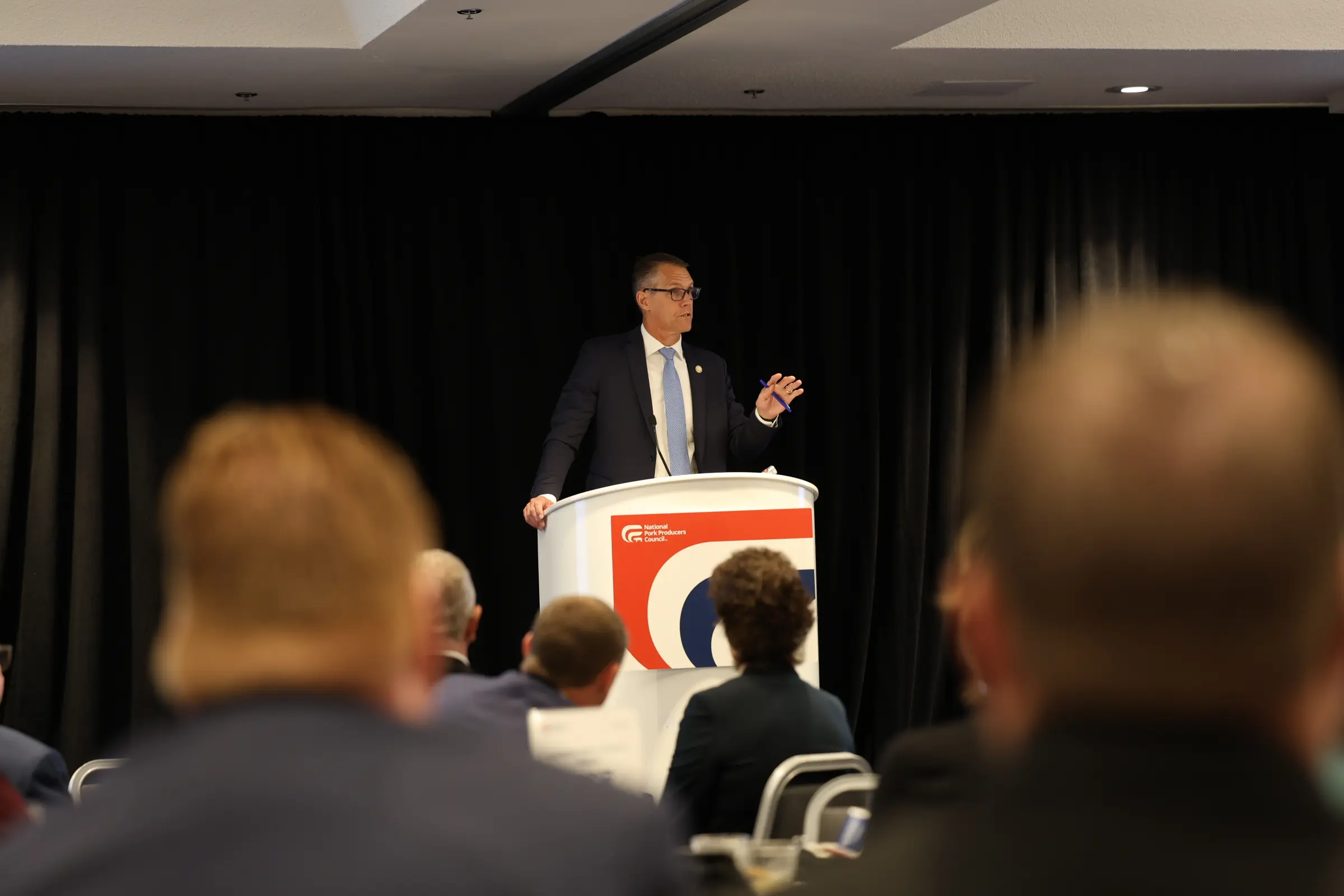
Before visiting Capitol Hill to meet with their members of Congress, producers heard from U.S. Department of Agriculture Under Secretary for Trade and Foreign Agricultural Affairs Luke Lindberg and Rep. Randy Feenstra (R-IA), a member of the House Agriculture and Ways and Means committees. Lindberg discussed expanding and promoting agricultural trade, while Feenstra talked about, among other topics, prospects for a new Farm Bill and fixing California’s Proposition 12.
On Wednesday, NPPC President Duane Stateler, President-elect Rob Brenneman, Vice President Pat Hord, Immediate Past President Lori Stevermer, CEO Bryan Humphreys, and Vice President of Government Affairs Maria Zieba met in the White House and the Office of the U.S. Trade Representative with Trump administration officials.
During visits with their lawmakers, producers:
- Called for passage of a new farm bill that includes a fix to California Proposition 12, which has increased pork prices for consumers and set a precedent for a patchwork of various state mandates on agricultural producers.
- Raised concerns about the Make America Healthy Again Commission’s recommendations related to food production, which stigmatize modern farming.
- Asked that the H-2A visa program, which allows a limited number of foreign workers entry into the United States for temporary seasonal agricultural work, be expanded to allow year-round workers so it can be used by livestock producers.
- Urged support for efforts to grow exports by opening new and expanding existing foreign markets through trade agreements and market access deals.
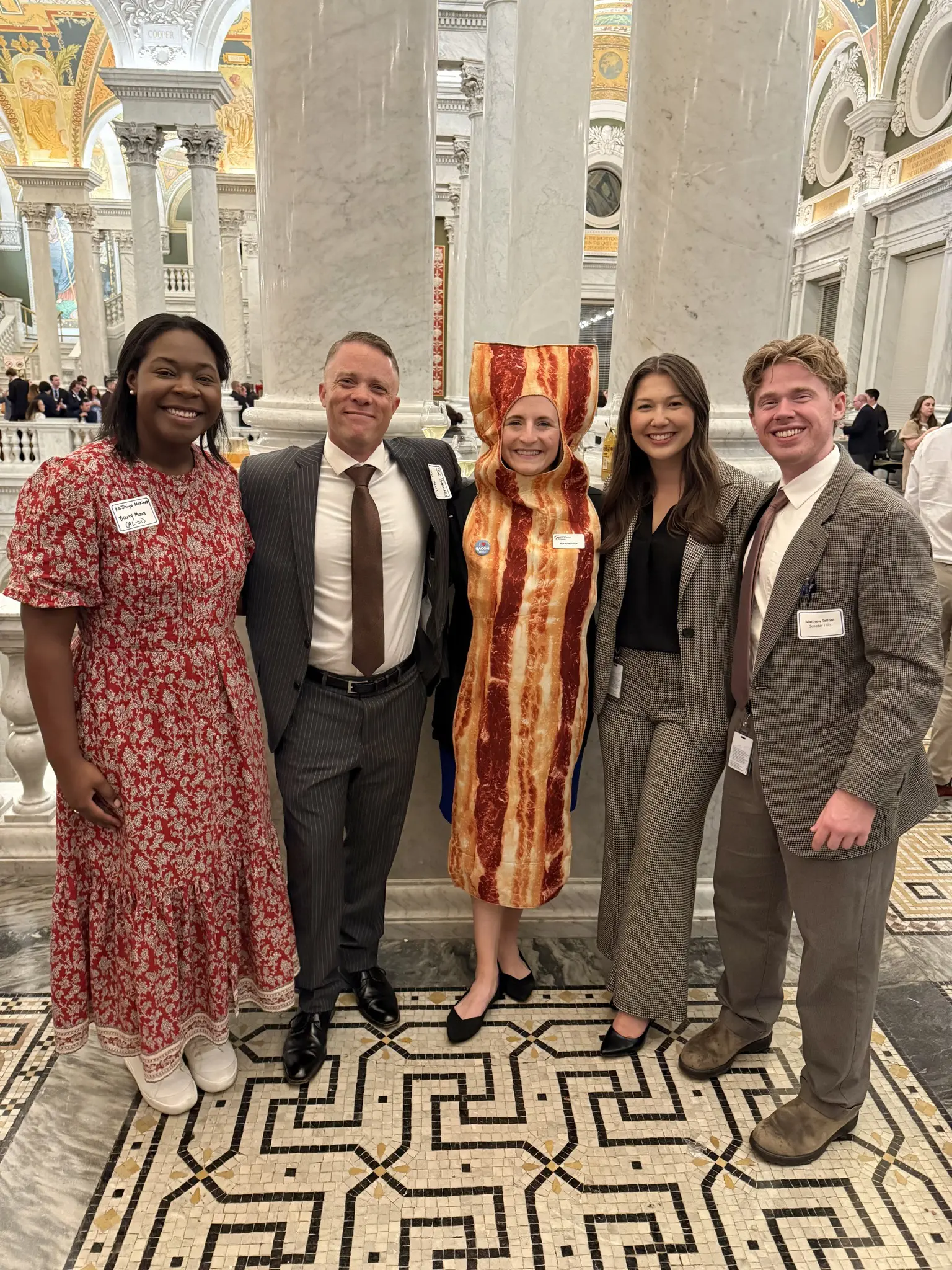
Wednesday evening, NPPC held its famous Baconfest reception, where 1,000+ guests, including members of Congress and their staff, embassy officials, and industry stakeholders, gathered to discuss pork industry priorities and enjoy a variety of delicious pork products.
Why it matters: NPPC’s biannual legislative fly-in is an important opportunity for its members to help advance various issues of importance to the U.S. pork industry and for policymakers to learn about the benefits the industry provides in their districts, states, and throughout the country.
Check out event photos below and more on NPPC’s Facebook page.
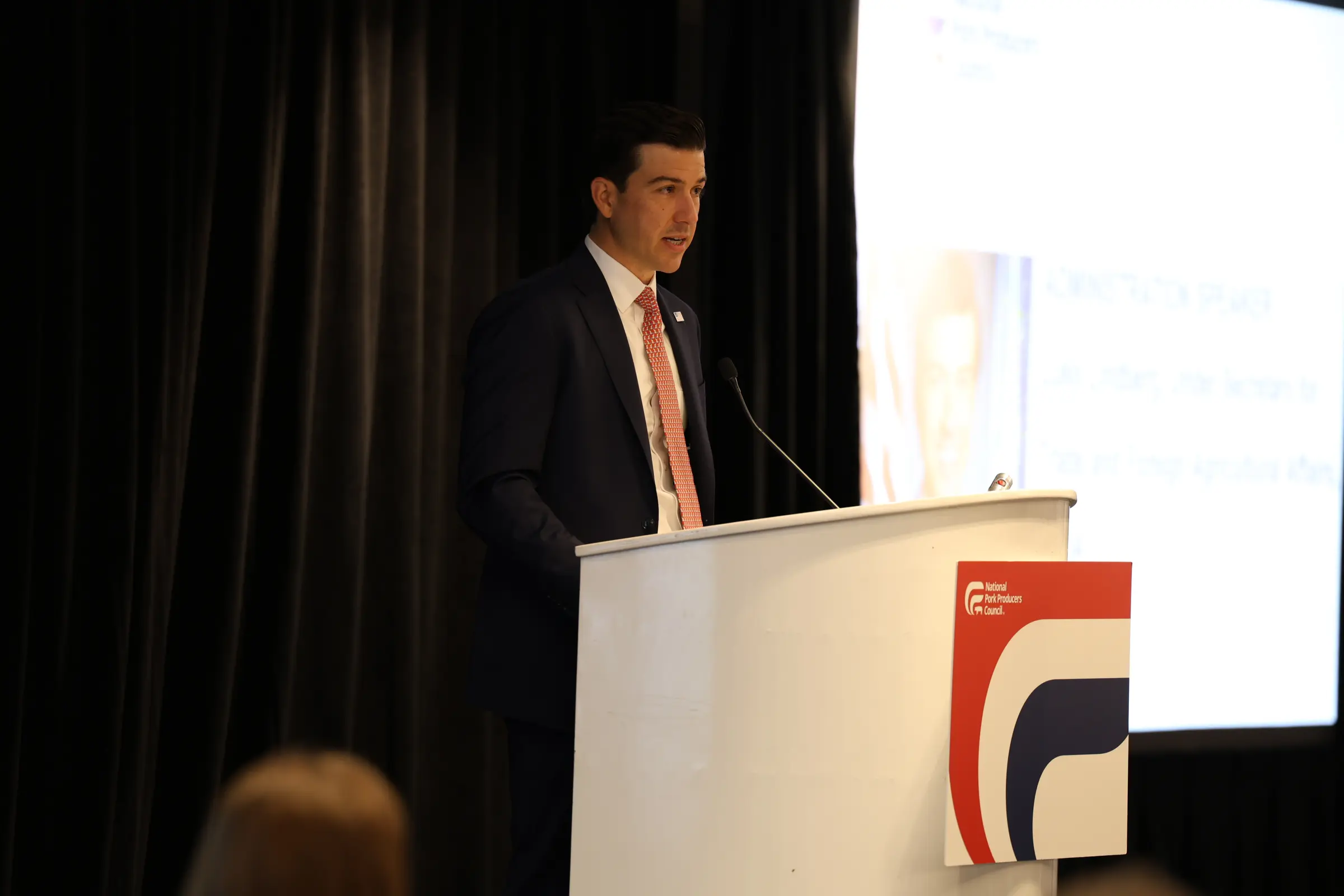
U.S. Department of Agriculture Under Secretary for Trade and Foreign Agricultural Affairs Luke Lindberg presents a trade update to 100+ pork producers.
Rep. Randy Feenstra (R-IA) takes questions from pork producers before they head to Capitol Hill.
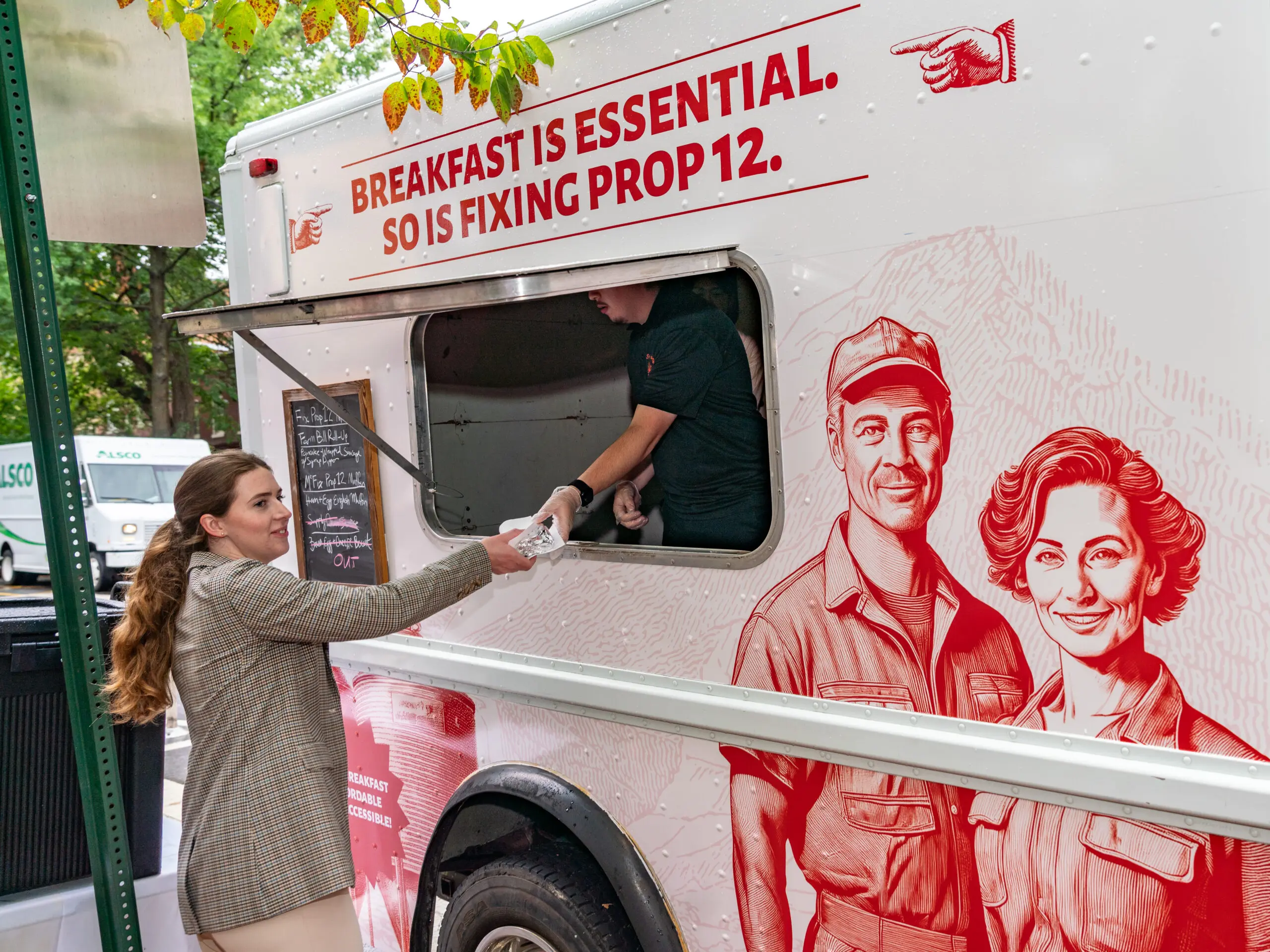
A Capitol Hill staffer grabs breakfast from the NPPC Fix Prop 12 food truck.
Capitol Hill staffers enjoy Baconfest with the evening’s mascot.
MAHA Commission Strategy Shows Signs of Listening to Pork Producers, Still Requires Education
What happened: The Trump administration’s “Make America Healthy Again” Commission released its “Make Our Children Healthy Again” strategy, which aims to address childhood chronic disease but also has potentially heavy impacts on farmers, sound science, and healthy food. These impacts remain a concern, but the strategy shows signs of progress from the initial MAHA Commission report in May.
The strategy incorporates a range of initiatives that risk stigmatizing modern farming while deviating from President Trump’s directives related to food security, safety, and affordability. And the regulatory expansion outlined in the report could lead to increased litigation against American businesses, including food and agriculture.
Following the initial report from the MAHA Commission, NPPC recommended:
- A fair and workable definition for “ultra-processed food”
- Protection of the use of food additives that enhance food safety, shelf life, and nutritional availability
- Exclusion of animal feed from reforms to the “generally recognized as safe” standard to protect animal health
- Adoption of a risk-based approach – versus hazard-based – for determining the safety of technologies used in food production
NPPC’s take: Following the initial MAHA report, NPPC voiced its concerns publicly and in meetings with the Trump administration. NPPC warned against the dangerous language used to describe farmers’ work and offered to partner in transparent, risk-based research to further public health. NPPC is pleased with many of the steps taken in the strategy released this week but emphasizes there is more progress to be made:
NPPC President Duane Stateler, a pork producer from McComb, Ohio, said, “While agriculture’s voice was widely unheard in the initial MAHA report, we thank the administration for listening to our concerns before releasing the ‘Make Our Children Healthy Again’ strategy. We all want to help our children be healthy, yet there is still more work and understanding for this goal to best be accomplished.”
Why it matters: The MAHA Commission’s recommendations could make it more difficult for farmers to have access to products and technologies that have helped them produce the world’s safest, most abundant, and most affordable food.
Groups Urge Congress to Develop, Pass New Farm Bill
What happened: NPPC joined 263 other agricultural organizations in urging Congress to “prioritize the development and passage of a Farm Bill 2.0 that fully reflects the evolving needs of American agriculture.”
In a letter led by Farm Credit Council sent to Senate Majority Leader John Thune (R-SD) and Minority Leader Chuck Schumer (D-NY) and House Speaker Mike Johnson (R-LA) and Minority Leader Hakeem Jeffries (D-NY), the farm groups urged the lawmakers to “devote the necessary resources to ensuring timely debate and action” on a new five-year blueprint for U.S. agriculture.
The last farm bill was approved in 2018 and was extended when it expired Sept. 30, 2023, for a year. That extension lapsed with the end of fiscal 2024 (Sept. 30), although some of the bill’s provisions continued through the end of the calendar year.
“Our organizations are deeply rooted in the rural communities that will be most affected, and we offer our collective voice and expertise to help shape a strong, forward-looking farm bill,” said the organizations, which extended their “support in any way that would be helpful to this effort.”
Why it matters: The five-year farm bill sets farm, conservation, forestry, and nutrition policy and authorizes various agricultural programs, including ones related to foreign animal disease preparation and prevention and export promotion.
In their letter, NPPC and the other agricultural organizations pointed out that the “full suite of programs across all farm bill titles is essential to the viability of our agricultural system and rural communities.”
Trade Associations Back Callahan for USTR Ag Negotiator Role
What happened: NPPC joined a coalition of 90 trade associations, representing farmers, ranchers, fishermen, producers, agribusiness, and rural America, in urging the Senate Finance Committee to approve and send to the full Senate the nomination of Julie Callahan to be the chief agricultural negotiator in the Office of the U.S. Trade Representative.
In a Sept. 5 letter to Finance panel Chairman Mike Crapo (R-ID) and Ranking Member Ron Wyden (D-OR), the organizations noted that Callahan has a “deep understanding of global agricultural trade … and a proven record advancing the interests of U.S. agriculture in complex negotiations.”
Callahan is currently the assistant U.S. Trade Representative for Agricultural Affairs and Commodity Policy, overseeing USTR’s efforts to promote the interests of U.S. farmers, ranchers, and food manufacturers. In President Trump’s first term, she served as a deputy assistant U.S. Trade Representative and senior director in the USTR Agriculture Office.
Why it matters: Swiftly confirming Callahan and filling the chief agricultural negotiator position is vitally important as negotiations continue on reciprocal tariffs and access for U.S. agricultural products with dozens of countries, said the associations.
The USTR chief agricultural negotiator represents the interests of America’s farmers and ranchers and the U.S. government in trade talks with foreign nations, working to reduce trade barriers, open new markets, and eliminate unfair trade practices.
Applications for Pork Industry College Scholarships Being Accepted
What happened: NPPC is accepting 2026 Lois Britt Memorial Pork Industry Scholarship applications. Each year, ten $2,500 scholarships are awarded to college students who intend to pursue a career in the pork industry with aspirations of becoming industry leaders. CME Group and the National Pork Industry Foundation sponsor the scholarships.
Undergraduate students enrolled in a two-year swine program or a four-year college of agriculture are eligible to apply. Applicants will be evaluated on an essay addressing current or future issues facing the pork industry and offering potential solutions. Scholarship recipients will be announced in late January and recognized at the National Pork Industry Forum in Kansas City, Missouri, March 4-6, 2026.
Established in 1990 by CME Group and NPPC, the scholarship program honors former NPPC board director Lois Britt, a lifelong champion of agriculture. Britt spent 34 years with the North Carolina Cooperative Extension, followed by 15 years with Smithfield Hog Production in public and government relations. A few of her many achievements include induction into the NPPC Pork Industry Hall of Fame, the North Carolina Pork Council Hall of Fame, and the North Carolina 4-H Lifetime Achievement Award.
The application deadline is Dec. 12, 2025. Full eligibility and application requirements can be found here. For questions about the scholarship, please contact Jacob Sterle, NPPC director of industry resource development, at 515-278-8012 or invest@nppc.org.
Why it matters: “The future of our industry depends on the passion and commitment of the next generation,” said Duane Stateler, NPPC president and pork producer from McComb, Ohio. “This [Lois Britt Memorial Pork Industry] scholarship is about more than financial support. It is about encouraging young people to pursue their goals and providing opportunities for them to grow into the leaders our industry and communities will need in the years ahead.”