
Capital Update – For the Week Ending June 12, 2026
In the weekly recap from the National Pork Producers Council: NPPC urges producers to prepare for New World screwworm; North American agricultural, food groups urge renewal of USMCA; House approves ag funding bill with important producer provisions; FSIS to remove inspection requirement with food safety risk; NPPC, others file brief in Ohio feral swine law case; agriculture groups urge House to approve transportation bill; and NPPC’s 38th annual World Pork Expo a big success. Find out more below.

Listen to the Capital Update Here!
NPPC Urges Producers to Prepare for New World Screwworm
What happened: In the wake of confirmed cases of New World screwworm (NWS) in Texas, NPPC is asking pork producers to keep an increased eye on biosecurity.
NWS is a fly whose larvae feed on wounds/living tissue of warm-blooded animals. According to USDA, animals that recently have given birth, suffered an injury, or had a surgical procedure such as tail docking or branding are most vulnerable. NWS is not a food safety concern.
The first NWS case in the United States in 60 years was confirmed in a beef calf June 3 in Zavala County, Texas, and has since shown up in livestock in Edwards, Gillespie and La Salle counties in Texas and in a dog from Lea County, New Mexico. Over the past several years, NWS flies have moved northward from Central America into Mexico. They are endemic in Cuba, the Dominican Republic, Haiti, and some South American countries.
USDA and local animal health officials activated response measures, including establishing a roughly 12-mile (20 kilometer) infested zone around the detections; implementing quarantines, movement controls, and surveillance requirements within affected areas; and conducting targeted outreach and wildlife surveillance efforts. Agriculture Secretary Brooke Rollins in testimony before the U.S. Senate Agriculture, Nutrition, and Forestry Committee said her agency is prioritizing defeating NWS.
NPPC’s take: NPPC has been working with USDA, FDA, state animal health officials, the American Association of Swine Veterinarians, the Swine Health Information Center, and the National Pork Board to understand what a response would look like for the swine industry and to address concerns and gaps.
Why it matters: NWS has the potential to impact swine welfare and business continuity for producers throughout the U.S. Both Mexico and Canada have implemented temporary restrictions on certain live animal movements from the U.S.—including swine—to prevent the pest’s spread. Click here for more information on NWS.
North American Agricultural, Food Groups Urge Renewal of USMCA
What happened: President Trump has indicated the United States might not extend the U.S.-Mexico-Canada Agreement he negotiated during his first term in the White House. By July 1, the three countries must choose to renew the USMCA for 16 years, terminate it, or let it continue until 2036, with annual reviews.
NPPC and nearly 160 other agricultural and food organizations from the United States, Canada, and Mexico urged the trade agencies in each of those countries to strengthen and renew the USMCA.
The Agricultural Coalition for USMCA, of which NPPC is a member, sent a letter to U.S. Trade Representative Jamieson Greer; Dominic LeBlanc, Canada’s minister responsible for Canada-U.S. trade; and Mexican Secretary of Economy Marcelo Ebrard, pointing out that the agreement “strengthens the resilience of our integrated agricultural markets … All three nations share the responsibility of protecting and strengthening this competitive advantage, which is essential not only to economic prosperity but also to national security and regional stability.”
The coalition also sent a letter to House Agriculture Committee Chairman Glenn “GT” Thompson (R-PA) and Ranking Member Angie Craig (D-MN), asking the panel to “preserve and strengthen the agreement.”
That committee held a hearing June 10 on the trade deal, taking testimony in support of USMCA from half a dozen witnesses, including Michael Lichte, representing the Dairy Farmers of America; Jamie Beyer with the American Soybean Association; and Meat Institute Senior Director of International Affairs Michael Schumpp.
NPPC’s take: NPPC strongly supports renewal of USMCA, which has facilitated and streamlined the flow of commerce throughout North America. In 2025, for example, nearly $2.9 billion of U.S. pork was exported to Mexico and almost $759 million to Canada, making those countries the No. 1 and No. 4 markets for U.S. pork.
Why it matters: USMCA represents one of the largest trading blocs in the world, with more than 500 million people, $30 trillion in GDP, and a trade volume of $1.7 trillion. The agreement eliminated trade regulatory barriers for all three countries, increased regulatory transparency, and ensured science-based treatment of agricultural commodities and products.
House Approves Ag Funding Bill With Important Producer Provisions
What happened: The U.S. House approved the fiscal 2027 funding bill for programs related to agriculture, rural development, the Food and Drug Administration, and related agencies. The appropriations bill has funds for several programs of importance to pork producers, including:
- Swine Health Improvement Plan—an NPPC-backed national producer-driven, voluntary program to help deal with animal diseases such as African and Classical swine fever. It encourages pork operations to obtain certification that they are free from foreign animal diseases, outside control areas, which would allow pork to be moved in interstate commerce and international trade following an FAD outbreak in the United States.
- Market Access Program and Foreign Market Development Program—the U.S. Department of Agriculture’s export promotion programs are vital to the U.S. pork industry, which annually exports around 25% of its production.
- New World screwworm—An amendment offered by Rep. Paul Gosar (R-AZ) on the House floor, which lawmakers approved, would transfer $2 million to USDA’s Animal and Plant Health Inspection Service for increased inspections for NWS at U.S. ports of entry. APHIS would get $1.16 billion to protect American agriculture from foreign pests and diseases.
- USDA’s Food Safety and Inspection Service—increased resources to fund frontline meat and poultry inspectors.
NPPC’s take: NPPC supported passage of the House agriculture appropriations legislation.
FSIS to Remove Inspection Requirement with Food Safety Risk
What happened: In a victory for the U.S. pork industry, the U.S. Department of Agriculture’s Food Safety and Inspection Service agreed to end the requirements that swine slaughter workers cut open the mandibular (neck area) lymph nodes and manually feel the internal organs during inspections of swine carcasses.
Those actions are not necessary to ensure food safety, said FSIS in amending a meat inspection regulation that goes into effect July 20. It noted that swine condemnation rates are low, and condemnable disease conditions can be detected visually through other pathological changes in swine carcasses and parts.
NPPC’s take: NPPC supports amending the Federal Meat Inspection Act to end the mandatory practices of mandibular lymph nodes incision and viscera palpation of swine carcasses in all swine slaughter establishments.
Why it matters: Requiring lymph nodes incision and viscera palpation are not needed to ensure food safety, and research has demonstrated that visual-based post-mortem swine inspection procedures may reduce the probability of carcass cross-contamination by microbial food safety hazards. Removing the requirements for incision and palpation may improve food safety, according to FSIS.
NPPC, Others File Brief in Ohio Feral Swine Law Case
What happened: NPPC joined the Ohio Pork Council and the Ohio Farm Bureau Federation in filing a friend-of-the-court brief in support of Ohio’s effort to reinstate a law that prohibits the importation and hunting of feral swine and wild boar and eliminates the practice of feeding swine garbage in the state.
The groups are asking the Ohio Supreme Court to take up a case involving a hunting business and reverse a state appellate court ruling against the Ohio law. The statute was approved by the Ohio legislature to protect the state’s residents, farmers, and businesses from diseases and economic risks posed by feral swine and wild boar.
The lower court enjoined the law because it ruled it is unconstitutional under a “void-for-vagueness” doctrine and amounts to an unconstitutional taking from the hunting business.
In their brief, NPPC, Ohio Pork, and the Ohio Farm Bureau argue that the feral swine law is not vague since it clearly outlaws possessing, hunting, and feeding feral swine and wild boar. “Alleged difficulties in complying with a law do not render [it] unconstitutionally vague,” they said. On the taking issue, the organizations argue that the remedy is not to enjoin the law but for the hunting business to seek compensation under the U.S. or Ohio constitution.
The groups are asking the Ohio Supreme Court to take up a case involving a hunting business and reverse a lower court ruling against the Ohio law. The statute was approved by the Ohio legislature to protect the state’s residents, farmers, and businesses from diseases and economic risks posed by feral swine and wild boar.
They also contend the lower court’s ruling “runs afoul of the State’s interest in enforcing duly enacted laws” and “creates a conflict amongst the [state’s] courts of appeals regarding whether an entire legislative enactment can be enjoined or only the actual statutes that became law can be enjoined.” Click here to read NPPC’s brief.
Why it matters: Ohio’s feral swine law was intended to protect the state’s farmers and Ohio’s $3.5 billion pork industry from diseases carried by feral swine and wild boar. According to data from the U.S. Department of Agriculture, feral swine and wild boar cause an estimated $1.6 billion in annual agricultural losses in the United States. NPPC and the other groups pointed out that a recent outbreak in domestic pigs of pseudorabies originating in wild boar led to a partial halt of pork exports to Mexico.
Agriculture Groups Urge House to Approve Transportation Bill
What happened: Agricultural groups, including NPPC, are urging the U.S. House to approve legislation reauthorizing the Surface Transportation Act, which includes programs essential to maintaining and improving the nation’s road, bridge, and trucking infrastructure — all of which are critical to farm, food, and fuel operations.
The “BUILD America 250 Act,” which would reauthorize the transportation law for five years – from Oct. 1, 2026, through Sept. 30, 2031 – was approved by the House Transportation and Infrastructure Committee on May 22. It would authorize $580 billion for road, bridge, and rail safety improvements, establish a pilot program to allow six‑axle trucks to carry up to 91,000 lbs. on interstate highways and give a 10% axle weight variance for dry bulk haulers, streamline the CDL renewal process, expand hours‑of‑service and electronic logging device exemptions for livestock haulers, and support rural infrastructure investments.
NPPC’s take: NPPC supports the “BUILD America 250 Act,” which will help maintain and improve the nation’s transportation infrastructure.
Why it matters: The Surface Transportation Act supports U.S. agriculture and rural economies by ensuring roads and bridges are maintained, allowing inputs to reach farms and commodities to be transported to markets.
NPPC’s 38th Annual World Pork Expo a Big Success
What happened: More than 10,000 people attended NPPC’s 38th annual World Pork Expo – the world’s largest pork industry-specific trade show – at the Iowa State Fairgrounds in Des Moines June 3-4.
The event brought together pork producers and industry professionals from around the globe for two days of education, innovation, networking, and pork. Dozens of media covered Expo, which saw nearly 400 pork industry companies from North America, Europe, and Asia displaying their products and technologies throughout more than 300,000 square feet of exhibit space at the fairgrounds.
During a live panel discussion, NPPC’s leaders and advocacy experts explained how targeted strategies deliver policy wins, beneficial regulatory reforms, and better market access for producers, unpacking how policy work gets done in support of the pork industry at the federal and state levels.
NPPC President-elect and Ohio pork producer Pat Hord advocated for U.S. pork producers on a Farmers for Free Trade panel, highlighting the importance of the U.S.-Mexico-Canada Agreement.
Iowa Secretary of Agriculture Mike Naig updated members of NPPC’s Strategic Investment Program on the state’s animal health and biosecurity initiatives, trade, market access and current farm economy trends, key agricultural priorities advanced during the 2026 Iowa legislative session, and federal policy priorities.
The NPPC media center hosted a robust slate of reporters who took more than 80 interviews during “We Speak Up” Connect sessions with NPPC producer leadership and policy experts.
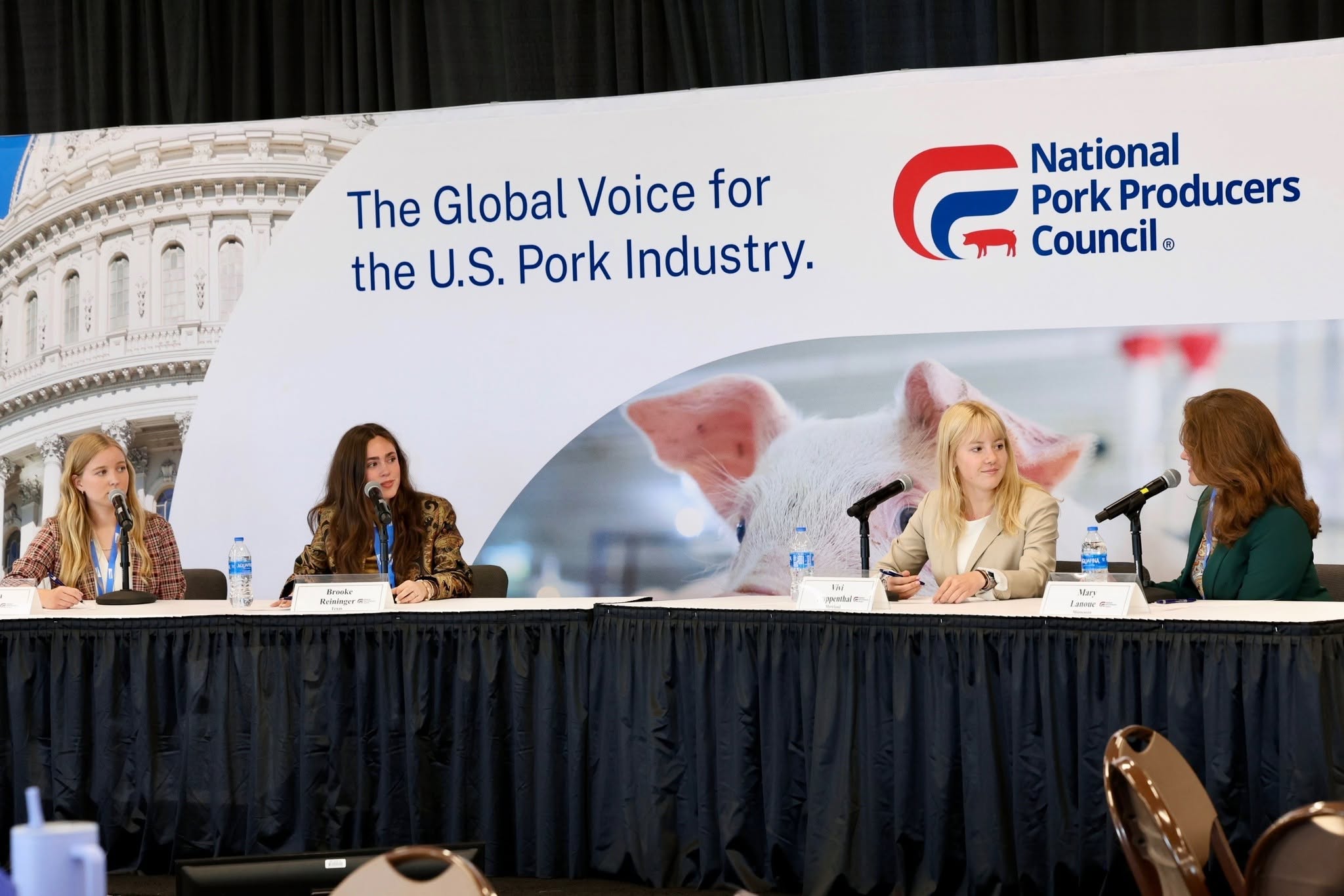
Among other highlights of Expo, NPPC held – for the third year – its Young Pork Advocates Issues Meet, a competition for young people aged 17-22. The competition is sponsored by Novus and Nutra Blend. Competitors engaged in open dialogues on pork industry issues and discussed and developed solutions for the issues, a method similar to NPPC’s process. After two rounds of competition, four finalists vied for top honors, with the winner—Amanda Ostrem from Iowa—earning a $10,000 college scholarship and a trip to Washington, D.C., for NPPC’s fall legislative fly-in. Vivi Ruppenthal from Colorado, Mary Lanoue from Minnesota, and Brooke Reininger from Texas (second-, third-, and fourth-place finishers, respectively) also received a total of $15,000 in scholarships.
Why it matters: World Pork Expo is the pork industry’s annual event, showcasing its latest products, innovations, and technologies and providing a forum for exchanging ideas and educating the public about pork production.
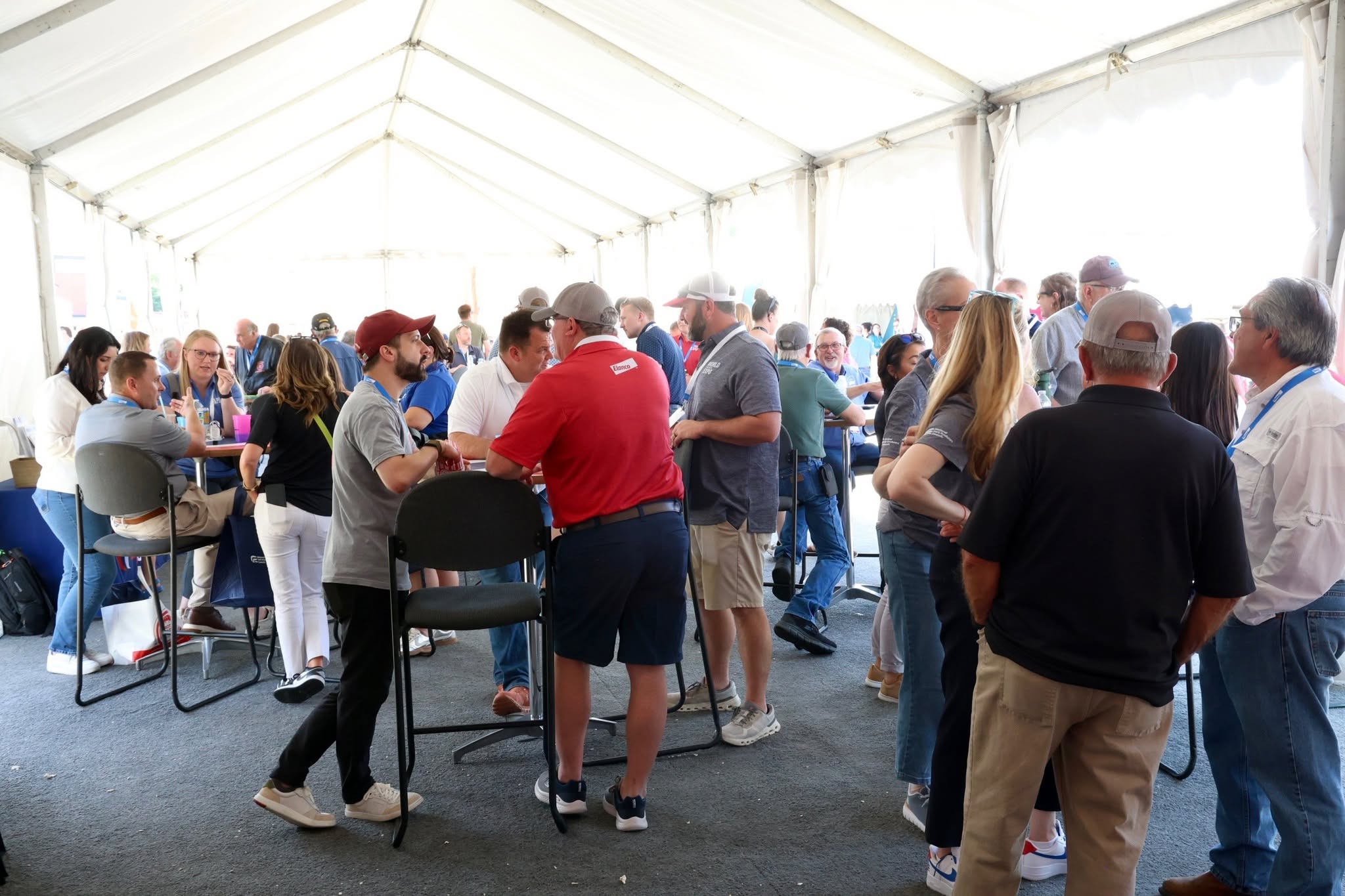
Pork producers and fellow industry professionals gather in the NPPC tent before lunch.
Students participate in the third annual Young Pork Advocates Issues Meet.
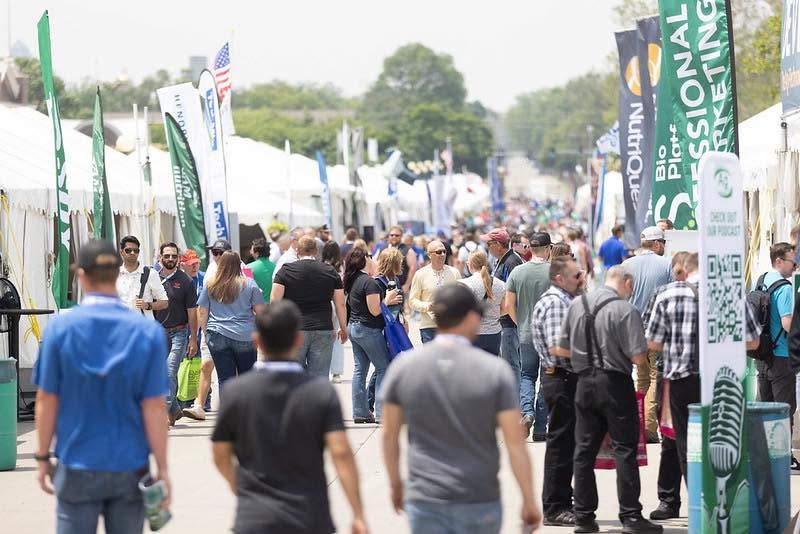
World Pork Expo attendees explore exhibitor booths.
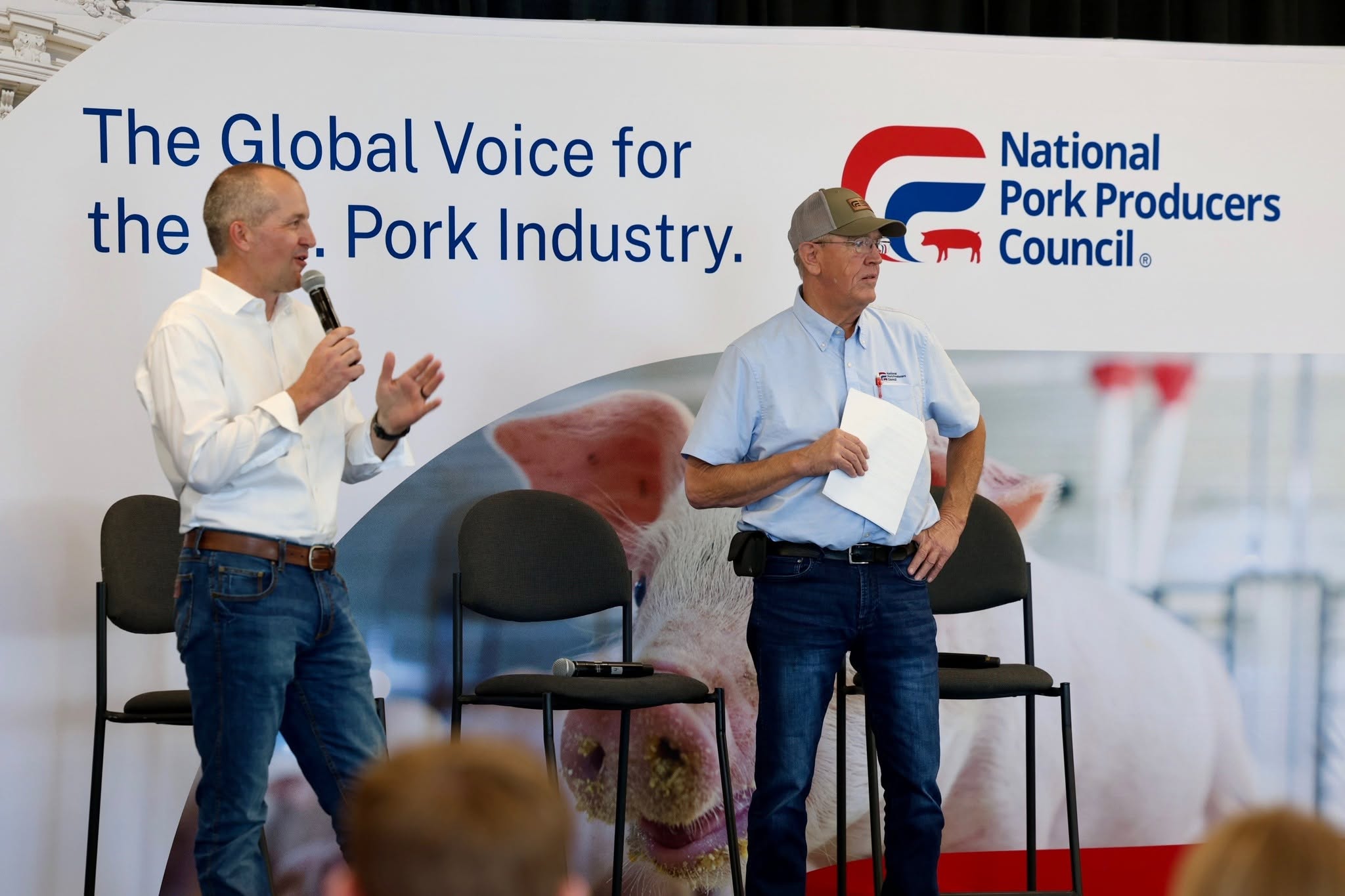
Iowa Secretary of Agriculture Mike Naig (left) and NPPC President and Iowa pork producer Rob Brenneman field questions on animal health.